
Preface for the Interested
It has been some time since my last post in April. The month of May treated me spectacularly, and while I was not writing, I was off taking many adventures, including the one about to unfold. This left me starting out June with a beautiful stack of experiences just waiting to be brought to digital life and in the process put a halt to my writing drought. However, the universe in its infinite system of checks and balances decided that the taxes for my May windfall should be paid in one lump sum just three days into the next pay period. The bill came in the form of wet cobblestone, an unfavorable coefficient of friction, and the disparity in the Moh scale of hardness between inanimate stone and the human elbow. This bill will cost me the months of June and July and temporarily the use of my left arm. Fortunately, my bike was not part of the deal. The result will be confronting this stack of unwritten posts and whether I have the constitution to tackle them one-handed. I doubt that I will want to expose my right thumb to stretching from shift key to shift key trying to get those capitals to start each sentence. In the meantime, I have a short reprieve before going under the knife where I have the limited use of my left hand, so I will take advantage of it by skipping ahead to the next to last hike chronologically. It is one that has a deeply personal connection, which I only recently became aware of. Of all the subjects in my stack, it is the one I was looking forward to writing about the most. Hopefully, afterwards, my absence will be shorter than expected. Until then, meet my great uncle Everett.
The Fresno Bee
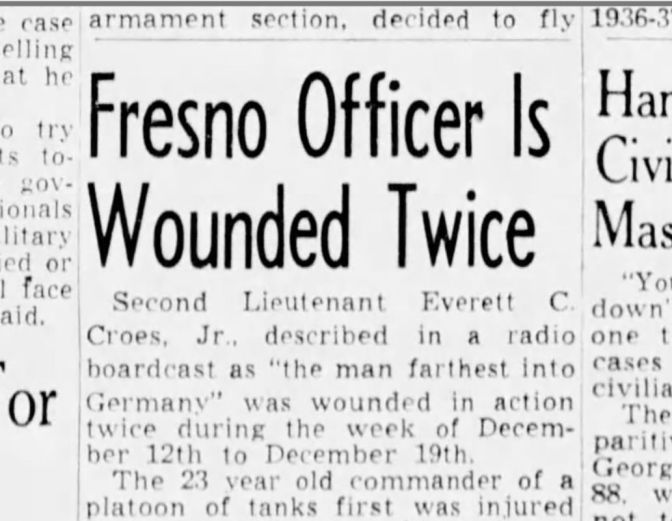
This headline on page 3 of the January 13, 1945 issue of the Fresno Bee would have been one of thousands like it published all over America as news of the heroic exploits of its hometown soldiers in World War II trickled back to every small town newspaper in the country. Writing from a hospital in England, 23-year old 2nd Lt. Everett C. Croes Jr., informed the Fresno Bee that he had “no broken bones, and is able to walk around, his worst inconvenience being that his left arm is taped to his side.” Just two weeks earlier on New Years Eve, the Fresno Bee first wrote about Everett in an article beautifully titled Fresno Tank Platoon Chief Says War Is Nasty, Dirty Job. The paper describes him as “Somewhere on the European battlefront” seemingly unaware that he had already been put out of action on December 19.
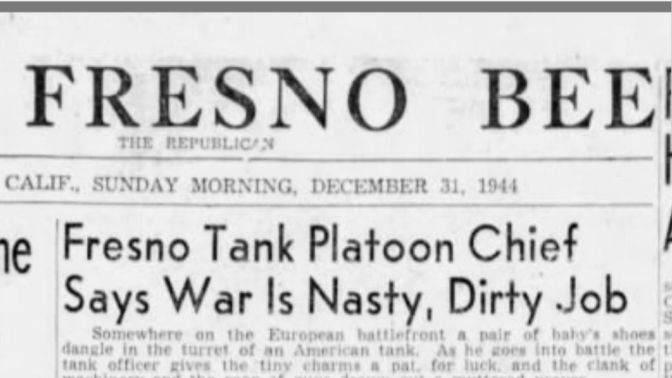
Like many soldiers, Everett sought solace in writing home to his young bride whenever possible. Whether writing from the turret of his tank or within the oppressive confines of a captured bunker, Everett shared whatever details he was allowed to share while not holding back on the emotional toll that fighting in a war takes on the human spirit. The article shares several excerpts of these letters. One can only imagine the horror a 1940’s wife would have reading these words from a husband who seems to be trying to explain the delay between letters; “Believe me, it is impossible to write under battle conditions. Here’s why — bullets whizzing around, artillery and mortar shells falling, and the situation always changing.” One can only imagine her thinking “Honey, forget the writing and keep your damn head down!”
While waiting for orders on September 25th, Everett wrote to his wife from inside a pillbox where he confessed “Darling, I’m changed, I think. Seeing war as it is is a terrible thing. There is no glory in it. There is no brave man.”
The orders Everett was waiting for would come soon after. The next letter occurs one week later, on October 3. In it, Everett recounts those orders and the events that followed. The orders were ones which have been issued countless times by military commanders since the dawn of warfare; orders which would strike terror in even the most hardened soul.
“Our mission was to take a hill….“
My Great Uncle
Everett C. Croes Jr. was the brother of my paternal grandfather. It has only been within the last couple years that I have started to learn more about this side of my family. The Croes family has spread like a finely-veined leaf across the entire continental USA. In LotR phraseology, I belong to the East Coast Bagginses and Everett was a scion of the West Coast Bagginses. This continental divide has left several gaps in the family narrative. It was only with the two news articles that I was able to embark on a personal journey to fill in some of those gaps, particularly in relation to what my newly found blood relative was doing in World War II. Of all my exploration of the sites of the Battle of the Bulge, the one thing that always felt missing was a blood tie. This journey would lead me to discover that I’ve crossed paths with his proverbial ghost without ever knowing it. But before I could get to that discovery, I couldn’t get this journey on the road until I figured out one thing.
Which hill was it?
Forest In Hell
“Speak of the Hürtgen Forest, and you speak of Hell.”
Road to Huertgen by Paul Boesch (1962)
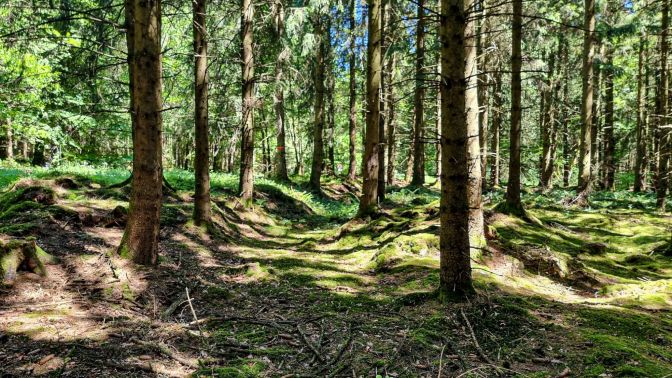
If you take a casual interest in World War II, it is likely that when you think about the American part in the defeat of Nazi Germany, the landings at Normandy, maybe the liberation of France, the Battle of the Bulge, and the discovery of the concentration camps will probably be the first things that come to mind. These tend to be the events which have made the best films and where the efforts of the Americans can be seen in the best light. But if you plot the aforementioned onto a calendar, you will see a huge glaring gap of roughly three months from September to December 1944.
During those months, several elements of the US military were engaged in a campaign to capture dams which controlled the Roer River. These dams were guarded by a dense forest of about fifty square miles which the Americans referred to as the Hürtgen Forest. The 1948-49 research report entitled Armor in the Hurtgen Forest describes the purpose of the campaign:
“The battle for the HURTGEN was primarily a battle for the ROER dams, The ROER RIVER was controlled by a series of head-water dams in the hills east of EUPEN (K798272) and in AACHEN the Americans had captured very complete engineering studies showing just what could be done with them.
In the event that the Allied forces north of the HURTGEN FOREST area succeeded in crossing the ROER it would be a simple matter for the Germans, choosing their time, to produce a flood which could effectively cut off these forces.”
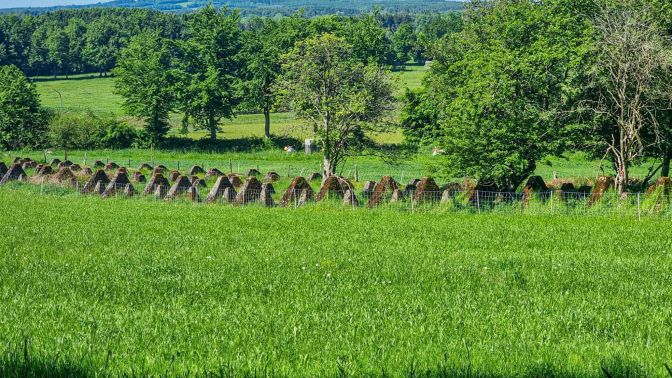
The strategy has been hotly debated, but the general consensus was that the campaign was a huge failure. Some estimates list the American casualties as up to 55,000 almost double that of the German estimated 28,000. Besides the questionable strategy, the Americans faced the obstacles of dragon’s teeth, “tall, closely packed fir trees” and “unusually severe” weather which had “turned the ground into a sea of mud”1. There is a reason Steven Spielberg and Tom Hanks haven’t made a movie or mini-series about it.
September 1944
“Optimism, an end of the war by Christmas, had infected the American forces by the first week of September 1944.”
The Bloody Forest by Gerald Astor (2000)
“This phase of the operation was devoted to the probing and reduction of the positions within the SIEGFRIED LINE. Advances during this phase were against stubborn defenses from the bunkers and pillboxes of the SIEGFRIED LINE. The reduction of these positions was undertaken one at a time, employing a variety of methods.”
After Action Report by Lt. Col. Clarence G. Hupfer C.O.
By mid-September the American forces reached the village of Lammersdorf, today just 500m from the Belgian border. As I would find out during my hike, the ridge to the north is covered with many of these former bunkers. But here, the Americans were stalled. To proceed further to the next villages such as Germeter, Vossenack, and Schmidt, they needed to secure a particularly frustrating landmark.
The Hill
“The hill was to consume the efforts of the battalion for the next two weeks since it was stoutly defended and commanded the terrain over which the battalion was ordered to pass.”
Armor in the Hurtgen Forest, 1948-49
To the locals, the hill would have been known as the Paustenbach Hill. To the American military, it was referred to as simply Hill 554. Attempts to take the hill were turned back several times. It wasn’t until September 29 when “…the battalion’s tank platoon swept around to attack from the east and southeast, that the hill was finally taken.”2 This was performed by Company C of the 746th Tank Battalion supported by 1st Platoon of Company A. Company A “outdistanced its supporting infantry and reduced the resistance in five or six pillboxes.” The infantry would follow and complete the taking of the hill. On Oct. 1, “1st Platoon Company A (was) released from Company C and reverted to Company A as of 0800.”3
October 3, 1944 Letter
To get to Hill 554, my great uncle writes “we had to cross a forest and take a lake and dam.” Clearing out the pillboxes seemed to be the main obstacle on the way to the hill as earlier described. “Things went fine, very little fighting. The hill was secured.” But after a quiet night where “we just sat”, German artillery chased the tanks back down the hill to the dam. With the infantry now arriving, the tanks provided supporting fire as Hill 554 was finally taken. Despite this, he describes the infantry as being “almost wiped out.” This infantry was the 39th Infantry Regiment, the element of the 9th Infantry Division that my great uncle and Company C of the 746th Tank Battalion would be attached to for the remainder of his service. The historical record seems to close the book on Hill 554 as of September 29, but as I would find out during the hike, soldiers were still dying on this hill in December. With Hill 554 and a brief description of the approach from the letter, I had a context to plan a hike. It was rather simple to locate the lake and dam. The result was only Chapter 1 in the footsteps of my great uncle Everett.
Hike Details
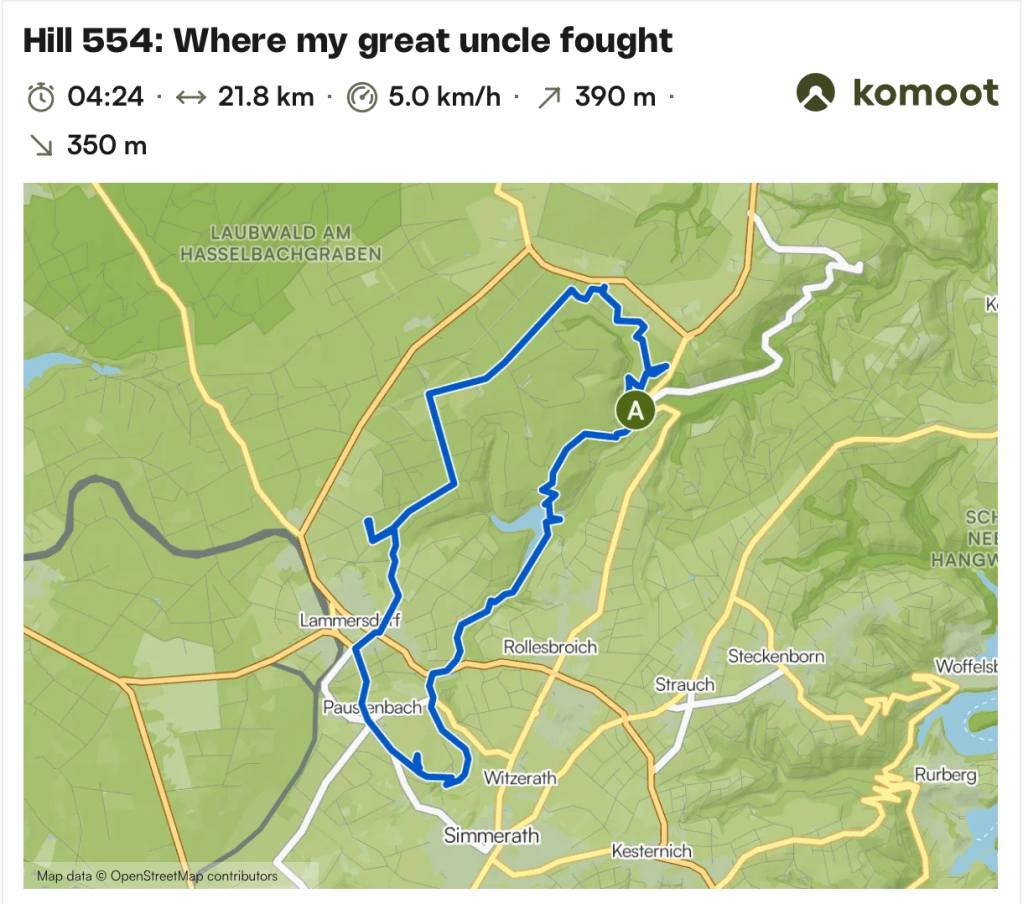
| Starting Point | Parking lot “Kallbrück Quarry” |
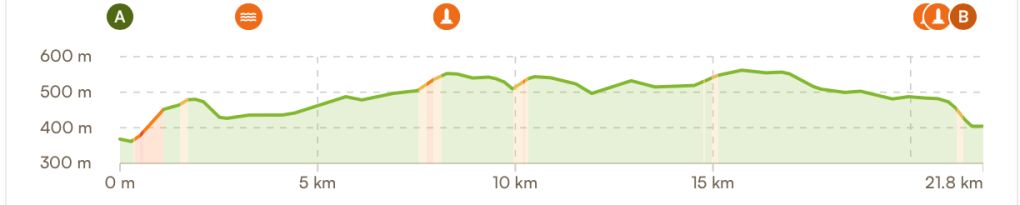
| Distance | 21.8km |
| My Moving Time | 4h 24m |
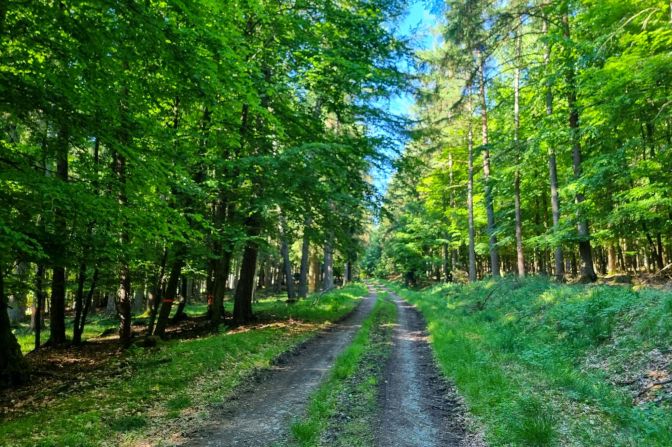
The Forest Pt I
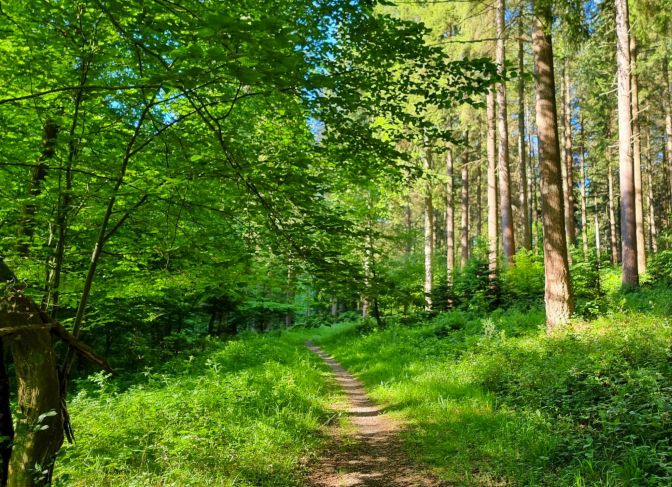
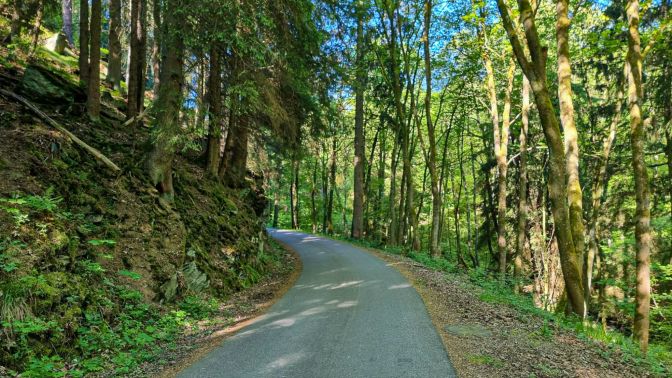
To pass through forest to get to the dam on the way to Hill 554 would have meant coming from the north as the hike does from the Quarry parking lot.
The Lake and Dam
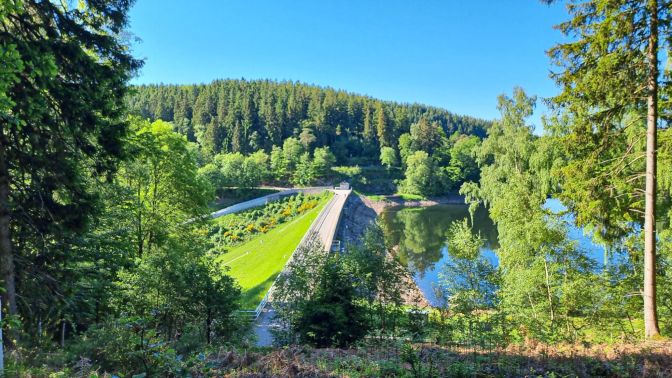
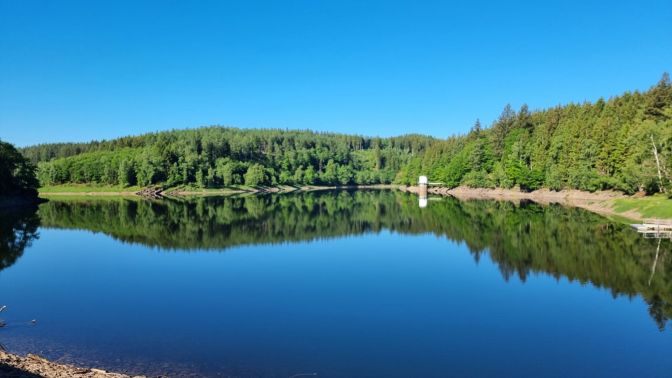
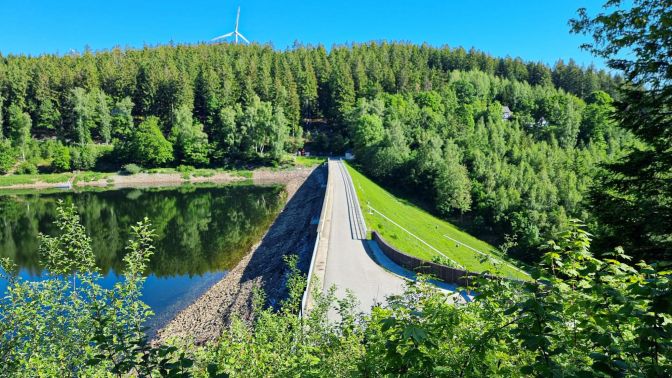
The lake and dam would be the Kalltalsperre.
Hill 554
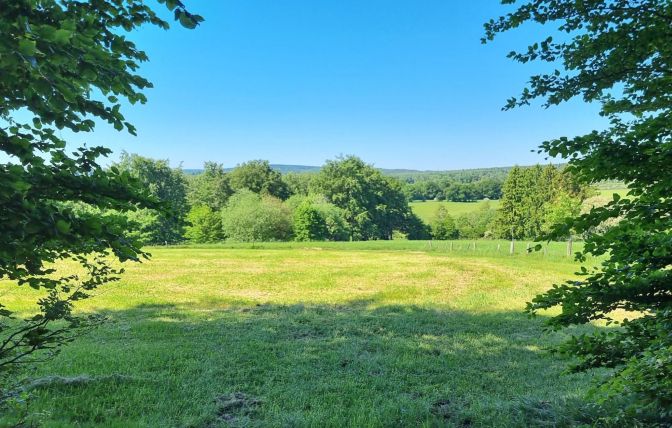
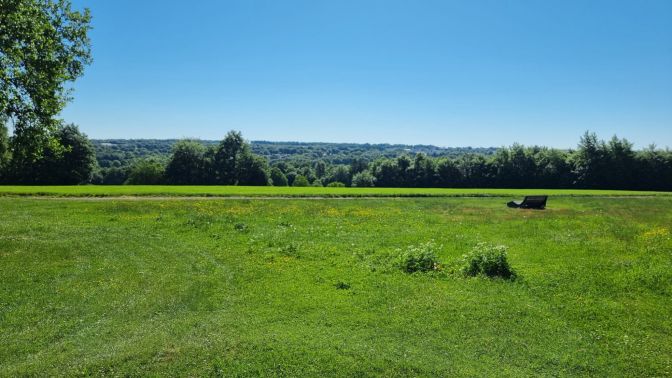
The first look of Hill 554 from the northeast.
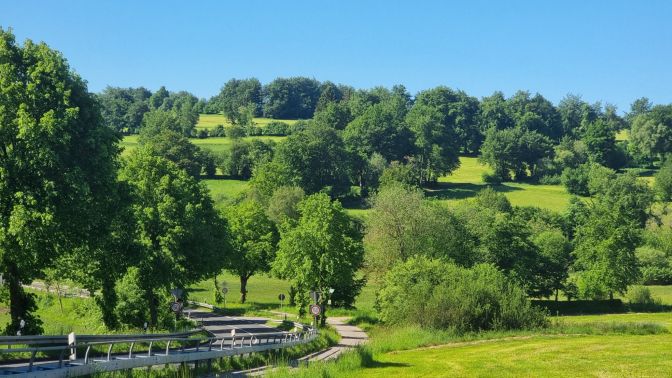
The route to the top of the hill swings around from the east and southeast.
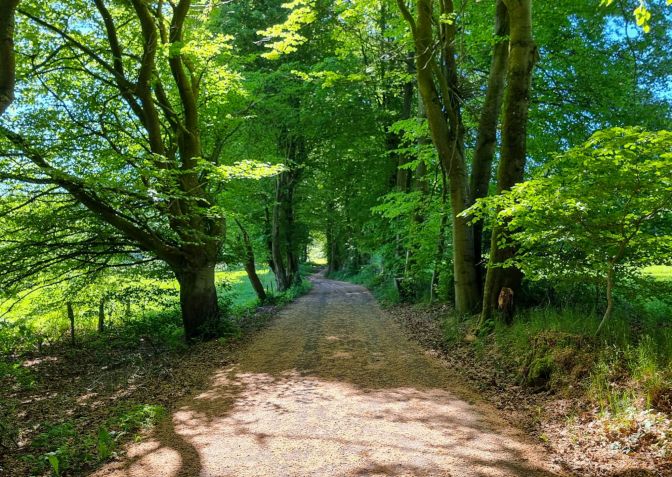
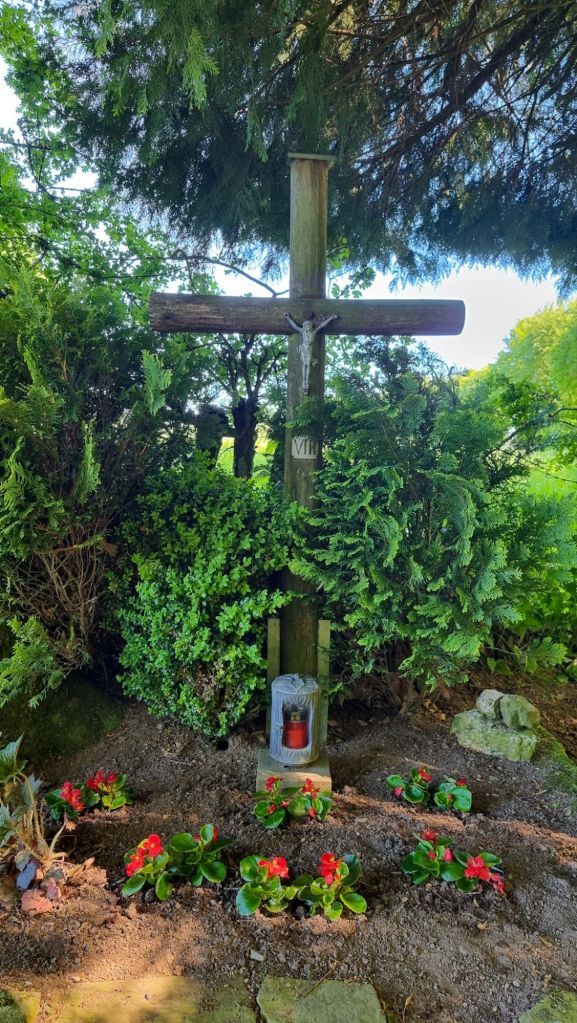
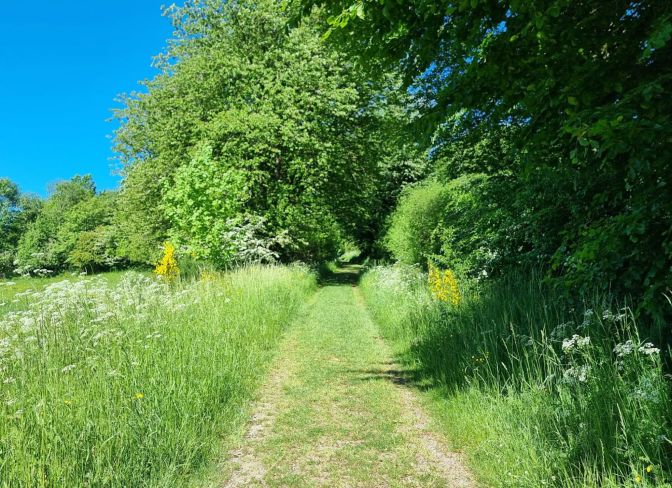
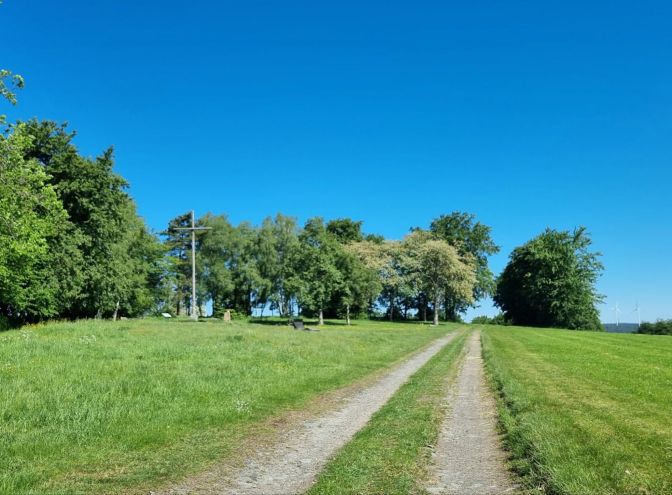
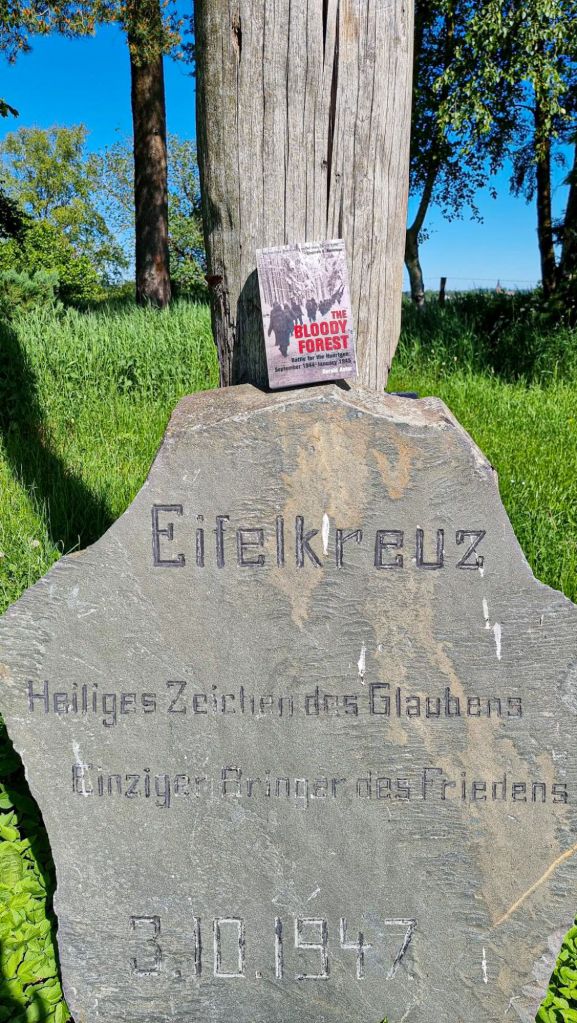
One can easily imagine this grassy plateau covered with Sherman tanks waiting for the infantry to arrive.
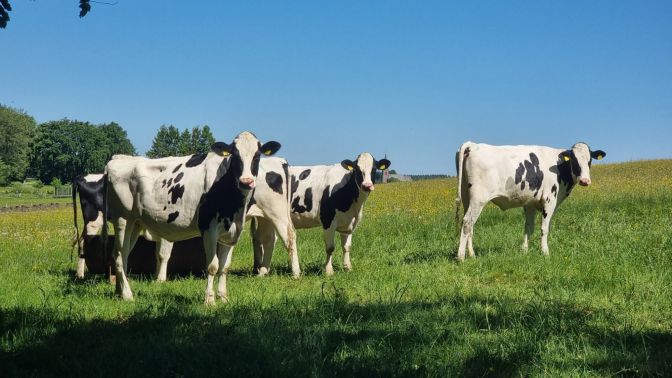
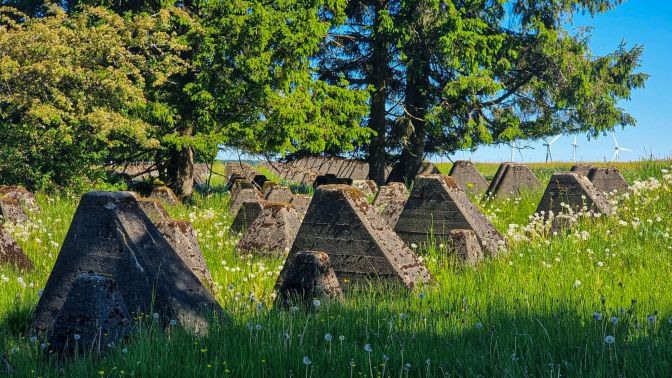
As you descend on the west side of Hill 554, several dragon’s teeth are seen.
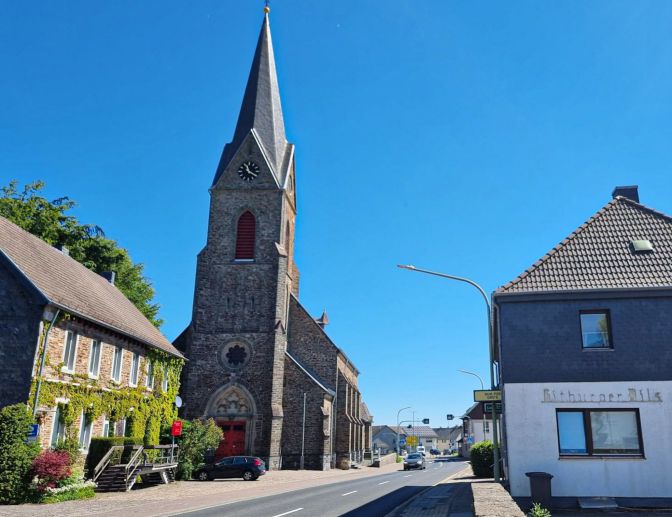
Lammersdorf
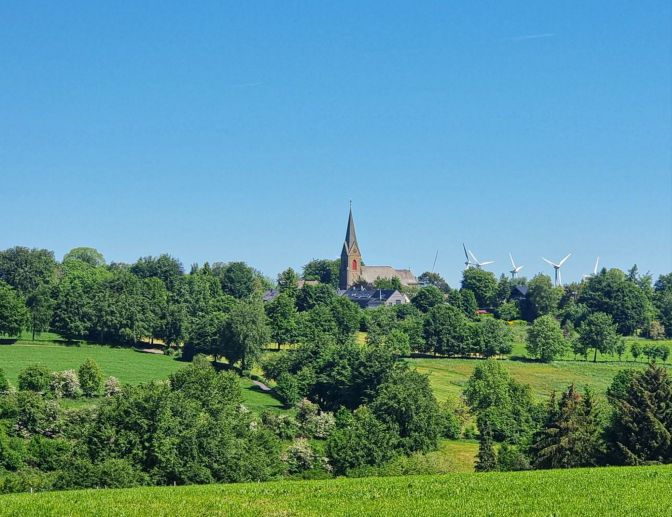
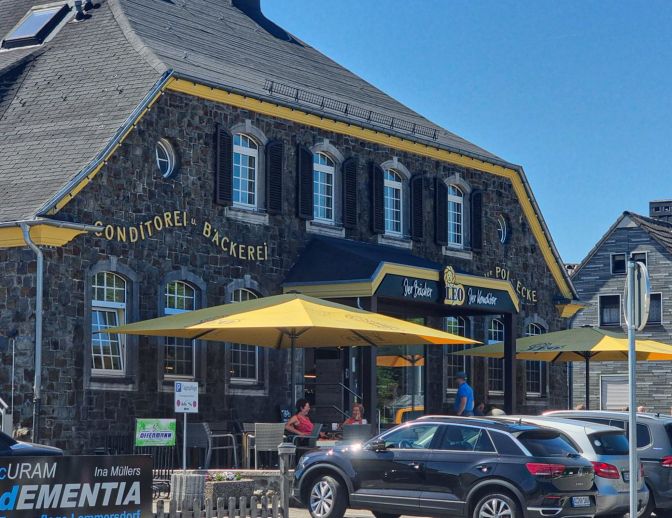
Heading northwest brings you to the village of Lammersdorf where you can stop for a refreshment at Leo der Bäcker. Sorry, no pub.
The Forest Pt II
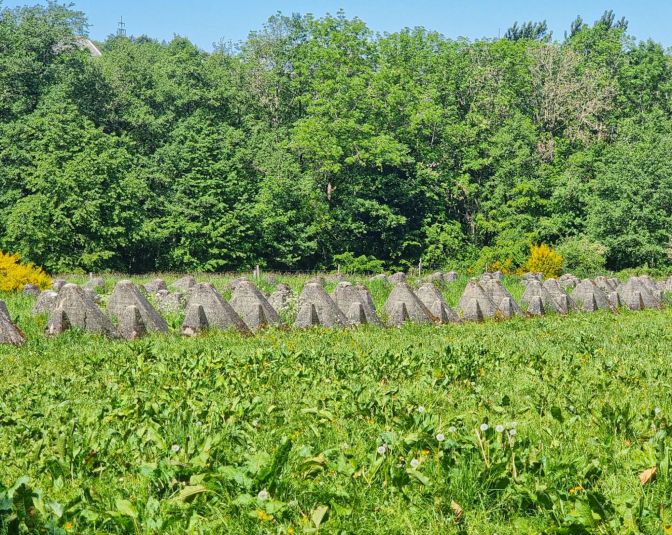
Heading northwest into the forest passes by more dragon’s teeth.
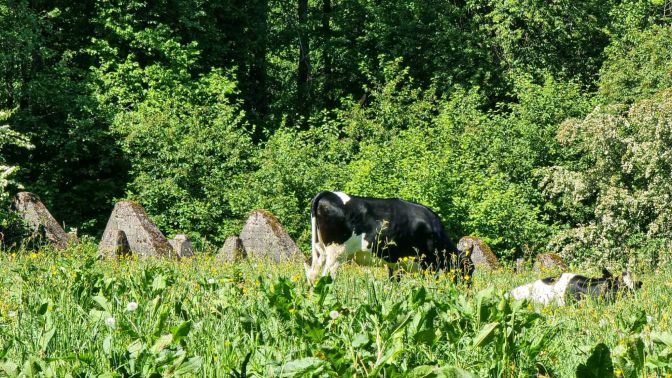
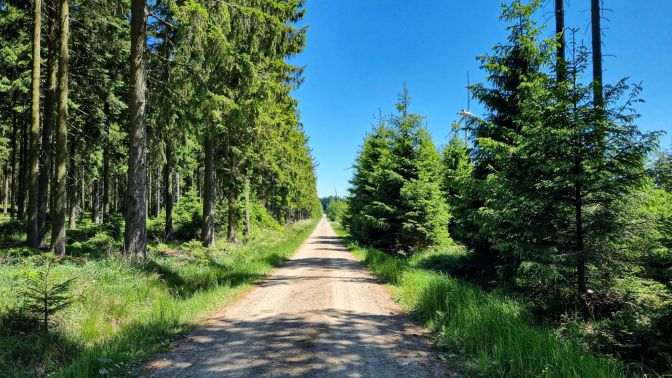
This forest is criss-crossed by uninteresting (and very exposed) but easy to follow logging roads.
The Bunkers
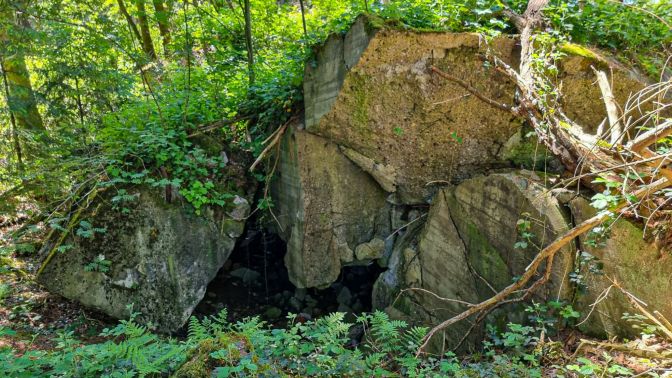
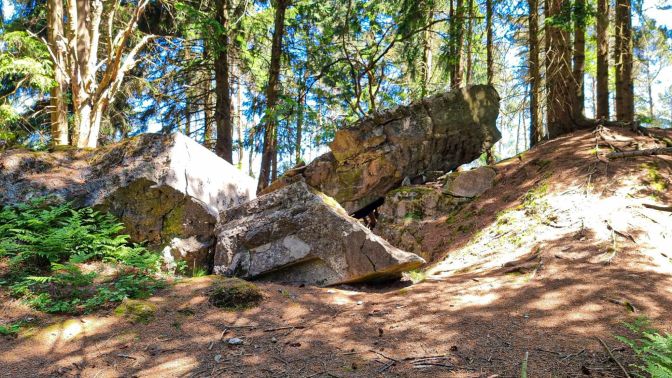
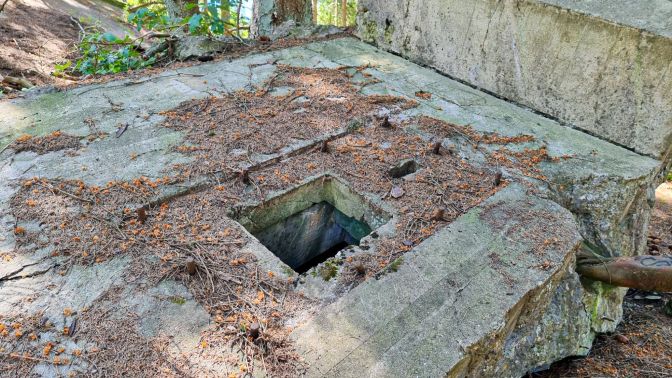
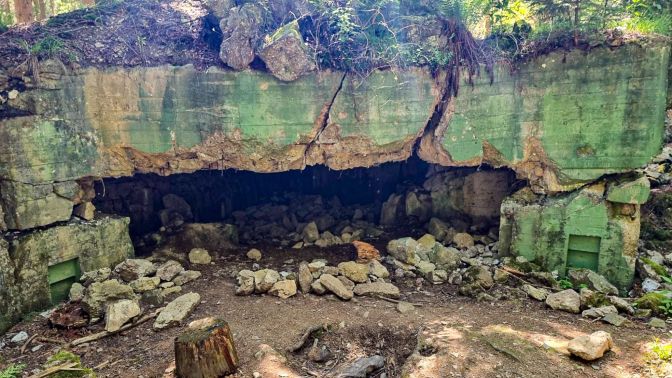
In this part of the forest there are several destroyed bunkers that you can find. Some take you off the main trail. The most interesting ones still retain some distinctive features while others are simply a jumble of formless concrete and rebar.
Memorials
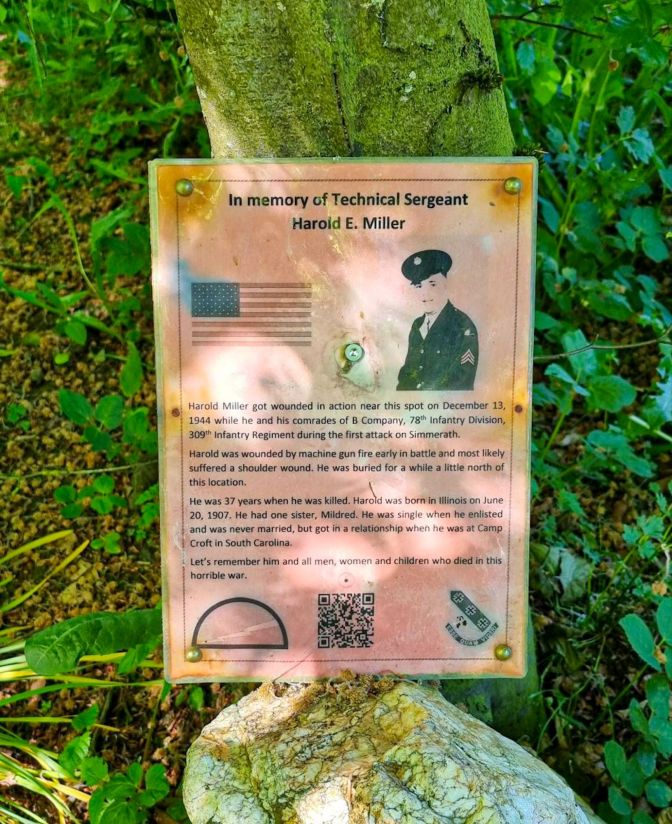
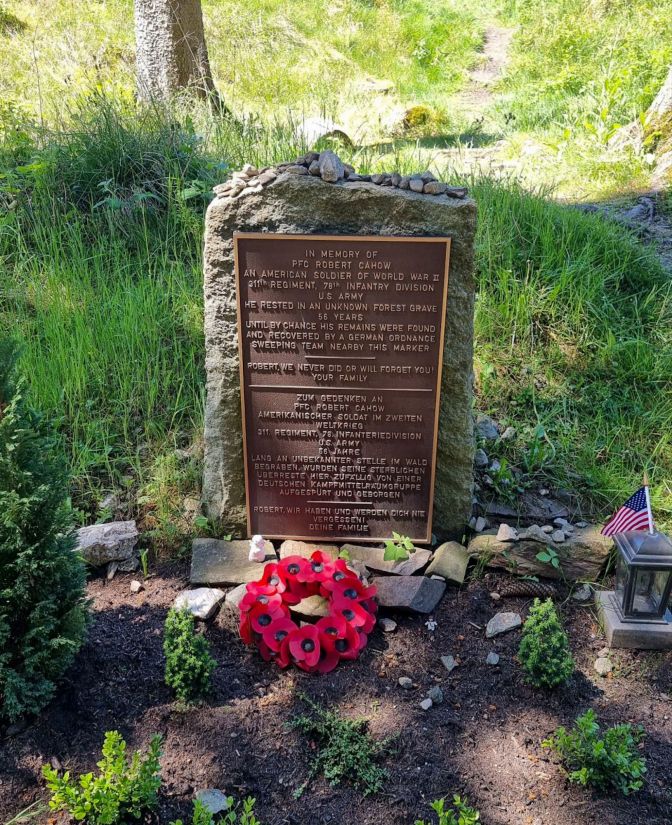
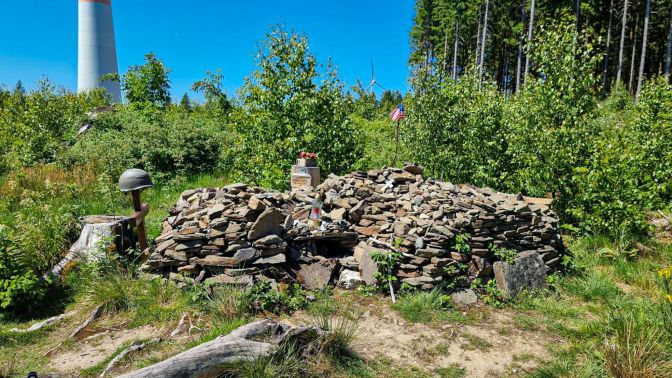
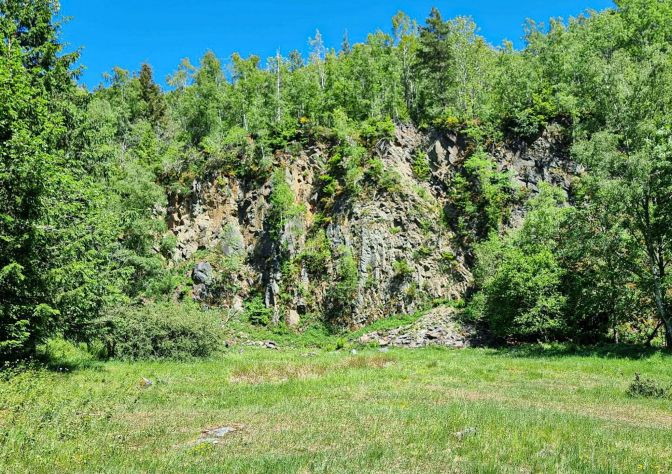
Towards the end of the route are a couple memorials where bodies were found decades after the war ended during a mine sweep of the area.
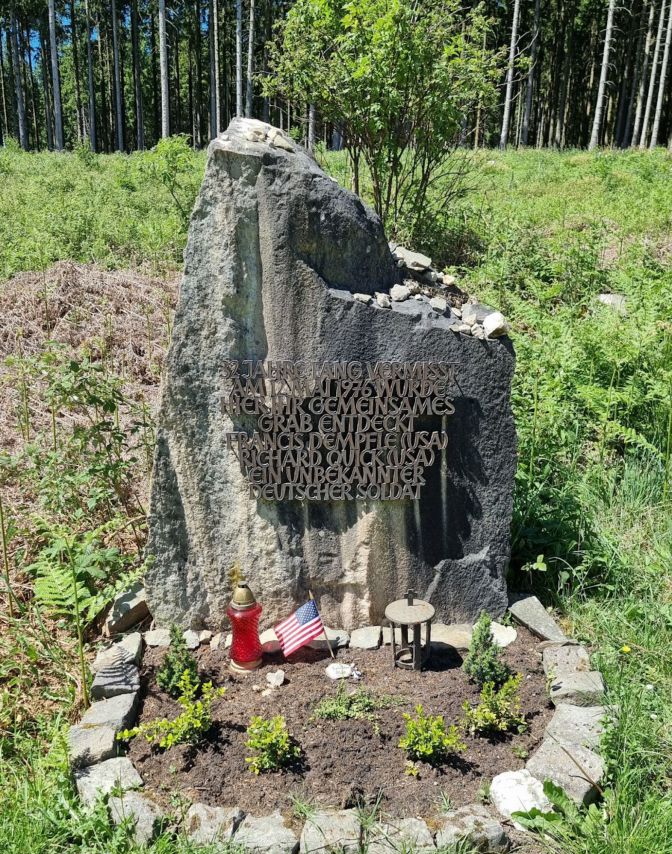
The other memorial was on a site where three bodies were found. Two Americans were identified as Francis Dempele and Richard Quick. The other was an unidentified German soldier.
Final Thoughts
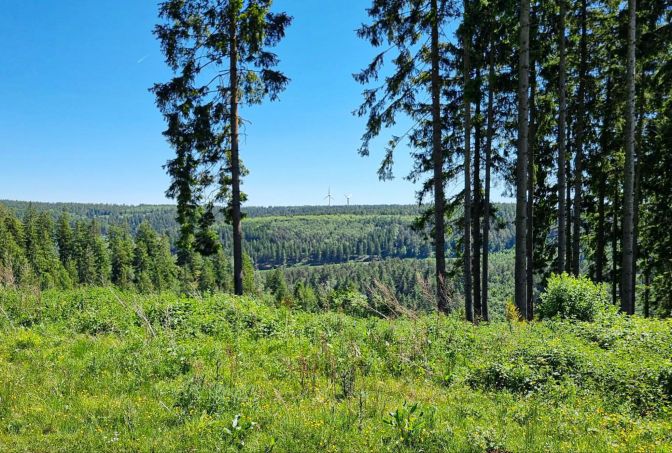
On a beautiful day in May, only the sound of birds and the mechanical whoosh of the giant windmills filled the satisfying pine-laden air. Try as I might, it was difficult to replace that with the sight of mist and mud and the cacophony of whizzing bullets, falling artillery, and the loud rumbling of the Sherman tank Ford engines. Further on in the letter of October 3, my great uncle writes “Last night we pulled into reserve and I found a nice house. It was almost dark when we got settled, so we built a big fire in the cook stove and made up a batch of hotcakes. Had some German blackberry jam for syrup. That with hot coffee and bacon really made a feast.” I will never know where that house was, but I can imagine the memory of that meal must have been a small plug in a wide dam of emotions that haunt a soul who has gone through battle. He and the rest of his company had little time to enjoy their respite though. On October 6, they were to begin an offensive to take the nearby towns of Germeter and Vossenack in support of the 39th Infantry Regiment. Thus set the stage for Chapter 2 of my personal journey and the hike of the following day.




To see my Uncle Everett’s story told in this particular way, about this particular hill, with this particular history, and with the particular author you are–one who happens to live near this particular place–was both fascinating and emotional for me. I cried a little and I don’t cry much. I know you’ve been thinking about this story for a while. I hope other members of the family respond, as I’m going to send the link around. Thank you, son. And great job!
LikeLiked by 1 person
❤️
LikeLike
How very, very interesting. Thanks so much for sharing.
And good luck with your recovery!
LikeLiked by 1 person
Thank you Barbara! 🙏🍻
LikeLike
I very much enjoy your articles and this one resonates a bit with me. My father fought in the 29th Division (the division was part of the D-Day invasion, but he did not join his unit in the 175th Infantry Regiment as a replacement until September 1 after the 29th had gotten off the beach, fought through the hedgerow country and liberated St Lo. He joined the unit at the tail end of the battle for the French port of Brest.
He once (and only once) told me about the time he was part of an attack on a German town only to get caught up in the German counter-attack which resulted in his having to hide in a cellar for a couple days until the town was retaken by other regiments in the 29th. He never gave me any more information beyond that, but I have been able to piece together from books about the 29th written by division historian Joseph Balkoski that this happened in mid-November 1945 in the town of Bourheim, which was one of the hamlets the various regiments of the 29th were picking up on their way to capture Jülich as part of the campaign to get across the Roer River. This area is about 17 miles northeast of Aachen and about 20 miles north of the Hürtgen Forest.
I have often considered mapping out a trip that would allow me to re-trace his path in his time with the 29th from his joining the unit in Brest through occupation in Bremen where he was discharged, and specifically would want to walk the general approach he took into Bourheim and perhaps continue on foot the additional two miles into Jülich. I would like to visit some of the other villages in the area the 29th captured, but several no longer exist, having been taken by the expansion of the massive lignite coal mines that are in the area.
I look forward to the next article about your great-uncle Everett and hope you heal quickly from your mishap.
LikeLiked by 1 person
Thank you for sharing your father’s story! I hope you get a chance to follow in his footsteps. I am still quite unfamiliar those parts of the war that you mention. There are so many unique threads and personal stories out there, and we must keep them alive. Thank you also for the well wishes. The recovery is going well and was able to finish the next part of my great uncle’s story.
LikeLike