
“It is one of the piquant ironies of modern European history that the birthplace of Nazism, ‘capital’ of the Nazi movement, and chief cultural shrine of the Third Reich had gained in the decades before Hitler’s arrival a reputation around the world as the most tolerant, democratic, and fun-loving city in Germany.”
Where Ghosts Walked: Munich’s Road to the Third Reich by David Clay Large (1997)
Starting out a blog post dedicated to classic art with a reference to the Nazis is probably not the best strategy for injecting a light-hearted, jovial mood. And any mention of Nazis and art in the same sentence could also lead one to misinterpret the intentions of this most noble endeavor. This will not be a look into the troubled soul of the Bavarian State Painting Collections, who is still today reaping the accusations of hiding Nazi stolen art during World War II. Nor will it be an examination of the folly of the Nazis stealing from their own museums, including evidence that two stolen from the Alte Pinakothek in Munich hung on the very walls of Hermann Goering’s palace1. No. I will shortly come to the point.
Part of the fun and challenge of my Drunken Masterpieces series is coming up with a unique theme for each museum I visit. Rarely when I make my way from the ticket counter to the first gallery do I have any idea what theme will transpire. The more of these I do, the harder it becomes, and such was the pinch of concern I faced as I climbed the long staircase to the second floor of Munich’s museum of the classics, the aforementioned Alte Pinakothek, during my Christmas 2025 holiday in Munich.
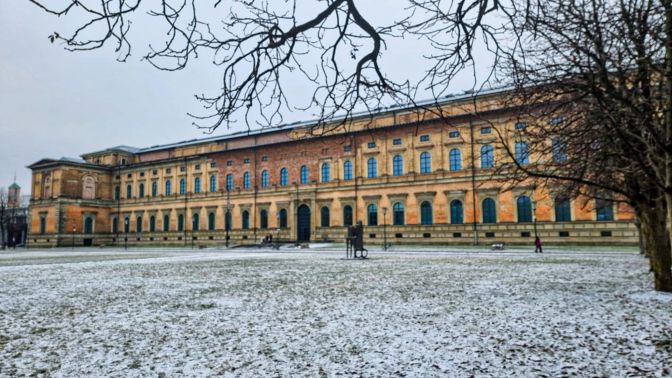
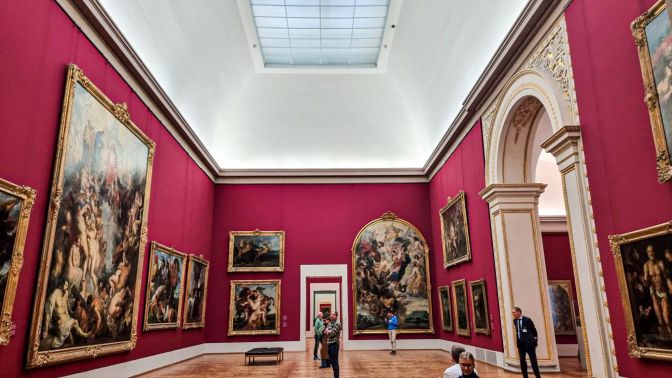
“…the old and new Pinakotheks contain some of the finest pictures in the world. Next to Vienna and Antwerp the former possesses the most exceptional collection of Rubens. Dürer (the greatest painter Germany has ever given birth to), Rembrandt, Van Dyck, Ruysdael, Van der Meer, Schongauer, Holbein and many masterpieces of the Flemish…”
A Brief History of Bavaria by Gertrude Norman (1906)
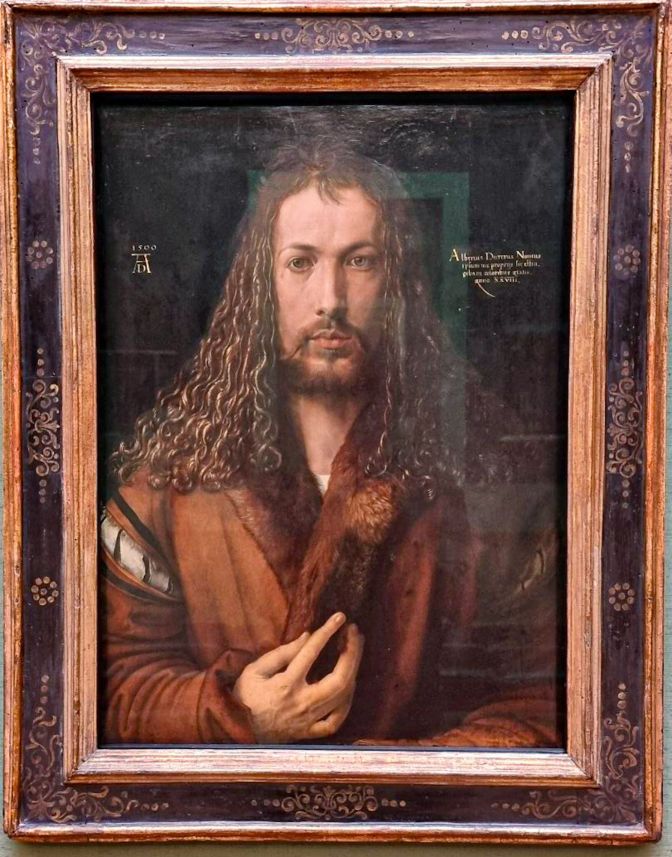
Wherever there are many masterpieces of the Flemish, you can be sure there are plenty of drunken masterpieces. I strolled through the impressive collection opening my spirit to the Art Gods looking for inspiration. Entering the galleries of the Alte Pinakothek, one is quickly confronted with the self-portrait of Albrecht Dürer (the greatest painter Germany has ever given birth to). Gazing at his portrait did not bring his guiding voice from the grave nor any ideas with it. But the man sure had pretty hair.
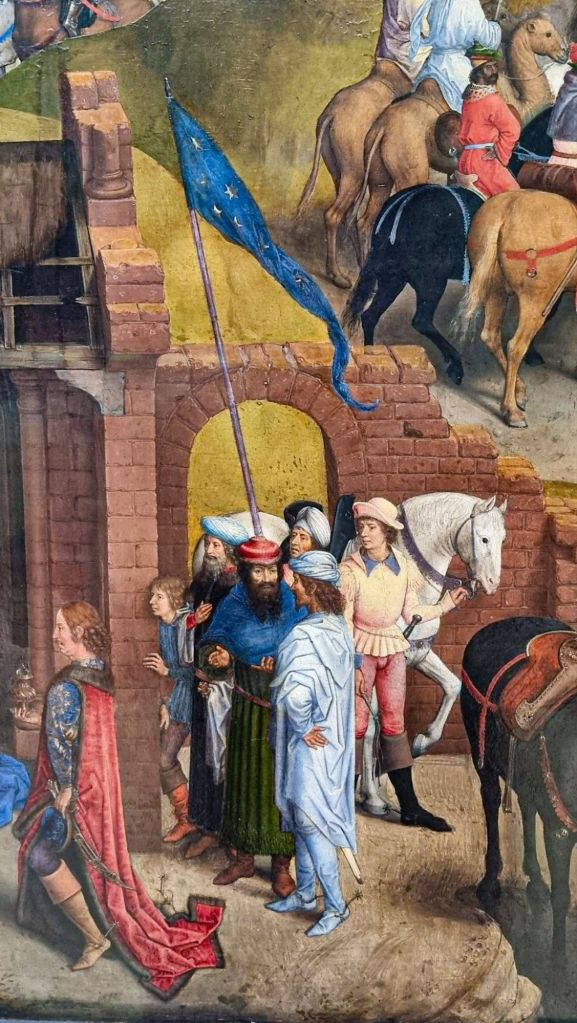
A little further on, Hans Memling’s name caught my eye. This famous Flemish painter from Bruges will always catch my attention. However, the title of the painting The Seven Joys of the Virgin didn’t fill me with hope. Upon further inspection though, several of the characters were wearing what looked like a toilet plunger on their heads with a flag on it. I guess long before the flushing toilet was invented, the red rubber plunger served a more noble purpose. But alas, one of several abandoned theme ideas early on.
Next up was this work from an anonymous master from Antwerp depicting the Adoration of the Magi. No harm in looking to my former hometown for a kick in the pants. The painting offered nothing, but it was the blurb describing it which wrinkled my brow.
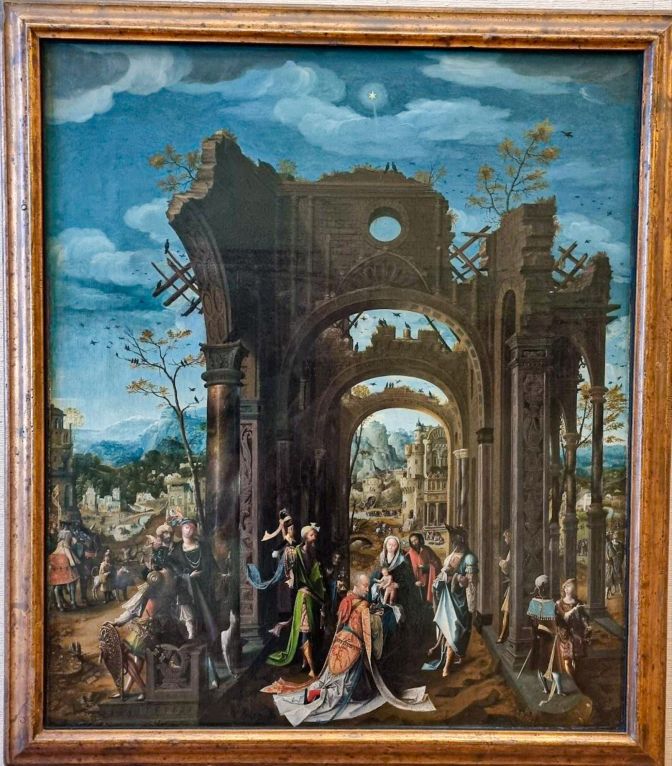
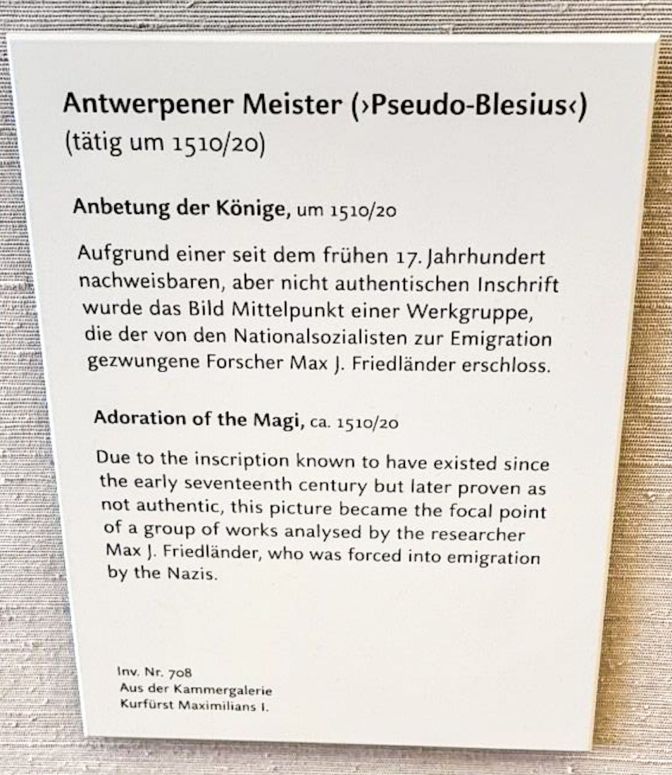
So what is important to know about this painting was that it was analyzed by a guy who was forced into emigration by the Nazis. For a brief second there, I considered the theme. But no. This post was not going to be about Nazis.
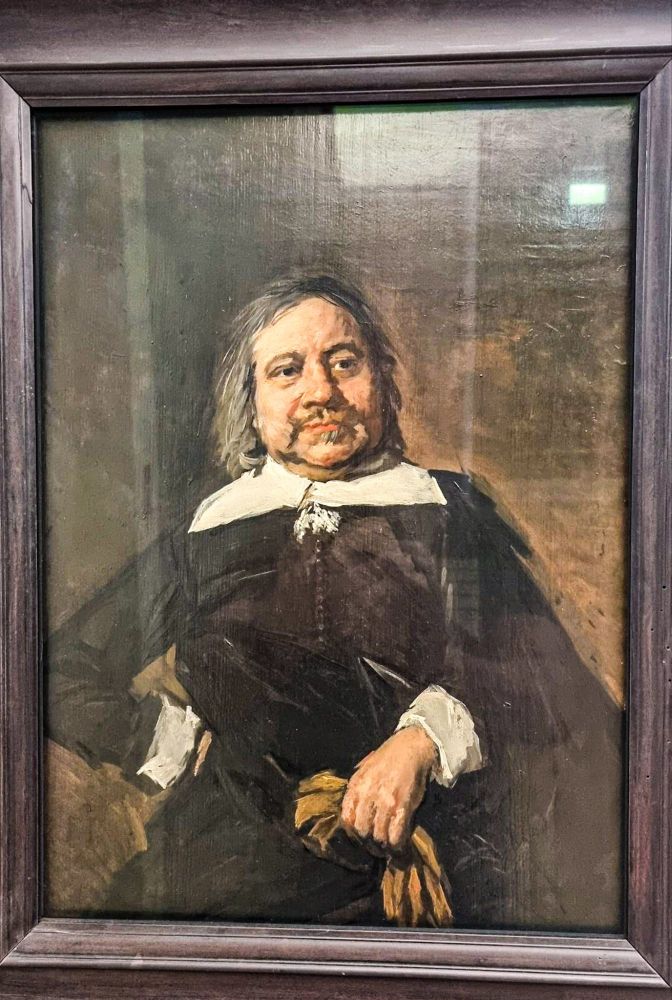
Would it be about my favorite painter, Frans Hals, who here has painted the brewer Willem Croes, a last name quite familiar to my family tree? Alas, there would be no ancestry theme.
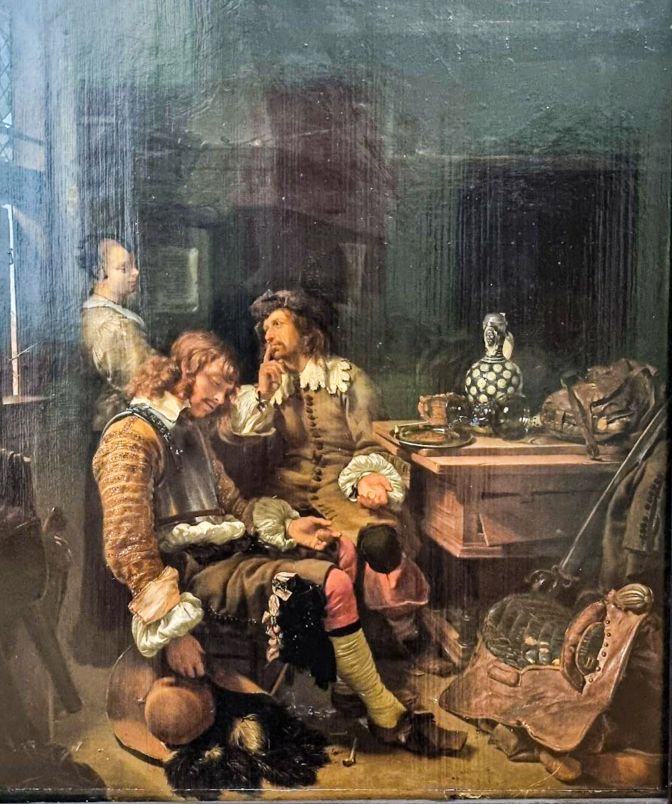
The theme would start to take shape upon reaching a work by David Tenier the Younger entitled The Inn which is described by the placard as a tour de force of closely observed still-life and having a mood of tranquillity.
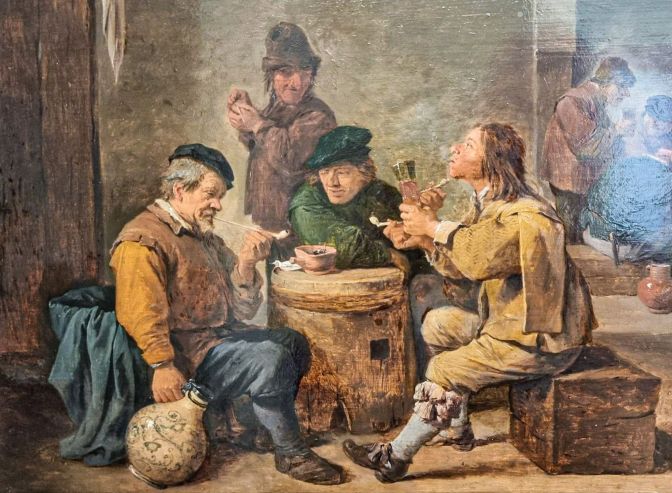
Indeed, it is a serene tavern moment composed of contemplative looks from the three main characters (are they Hobbitses?) which are only outdone by the Dutch soldier in this quiet tavern scene; the one sitting behind the sleeping soldier. As he stares out the window, he is clearly unconcerned about the war with England going on or the infestation of Heineken beer two hundred years later.
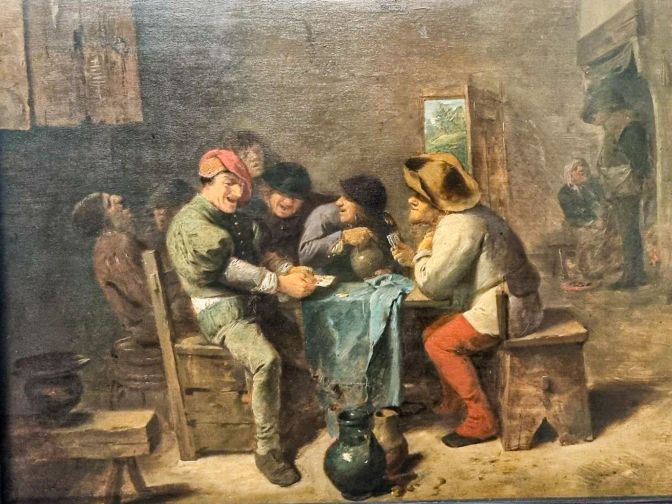
In fact, walking around this section of the museum could easily lull one into a beer buzz-like slumber with all the warm, cozy tavern scenes. But not all that goes on in taverns is sleepy. The Flemish and Dutch painters remind us that cards and dice games are a common accompaniment to the local ale. And with gambling comes a growing tension. In Adriaen Brouwer’s Peasants Playing Cards in a Tavern, you have one character who clearly isn’t a gracious winner as he lays down the winning hand with a smug look. His drunk cronies are laughing with mockery as the loser across the table looks on with suspicion, his red pants perhaps symbolic of his rising anger and the bloodbath that might take place moments later.
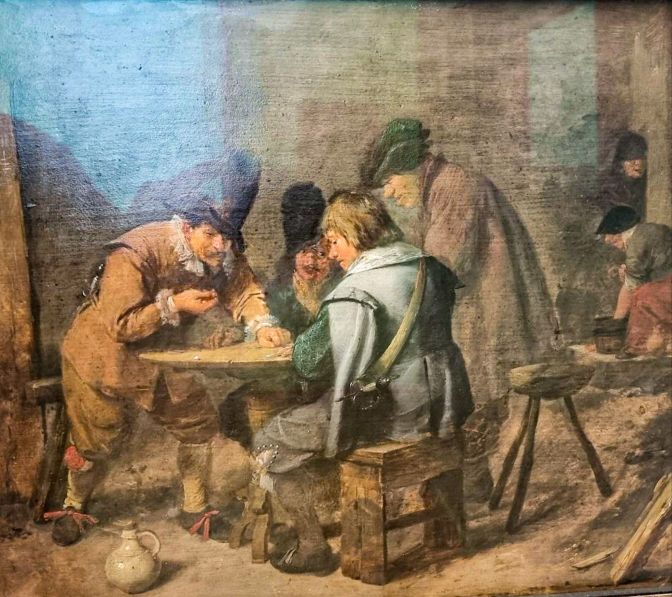
A similar vibe appears in another Adriaen Brouwer gem. Soldiers Playing Dice in a Tavern shows a player rising from his stool, incredulously stooping over the table as if noticing some tomfoolery from the well-dressed soldier sitting across from him. One can only wonder if the blond guy in green suddenly found himself eating a fist sandwich of dice and loose teeth soon afterwards.
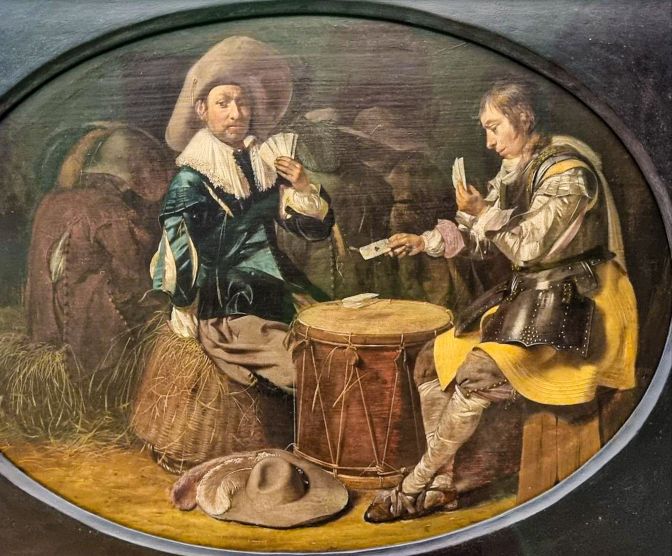
In this painting, Willem Corneliszoon Duyster’s Officers Playing Cards shows a soldier looking back at us with his right hand behind his back as if acknowledging he is about to cheat while his oblivious opponent is engrossed in his strategy. The fuse on this keg of gunpowder will soon be lit, and the guy on the left is inviting us to watch.
Fast forward to after the holidays, and I was at home starting the process of writing all of my blog posts about my Munich trip. Like I normally do, I spend some time reading through books in my book collection looking for quotes that will propel both my inspiration and narrative. One of these books was one which has managed to sit unread on my bookshelf since the moment I picked it up at a Half Price Books store in Houston, Texas somewhere in late 2010. In fact, the price sticker has a date stamp of Oct 7, 2010. I paid $3.00 for it.
The book was called Where Ghosts Walked: Munich’s Road to the Third Reich by American professor and historian, David Clay Large. I opened this post with a quote from it. I started with the Introduction (which has those annoying Roman Numeral page numbers which make them feel like they don’t count) but within a couple paragraphs, I realized I had struck gold. The theme I was looking for burst out of the forest like a Panzer tank in December 1944. Large introduces a quote which I have referred to from Robert Schauffler’s Romantic Germany in 1906, which goes “In the great beer halls where Munich spends many of its leisure moments, one man is exactly as good as another.” Then came Large’s response to that in the next paragraph:
“But such effusions, while no doubt true enough on the surface, disguised or overlooked another aspect of Munich’s beer hall scene: frequent brawls and riots, in which heavy earthenware steins, emptied of their liquid bliss, became dangerous weapons.”
Where Ghosts Walked: Munich’s Road to the Third Reich by David Clay Large (1997)
According to Large, fighting with a beer stein could earn you the title Schoppenhauer, or beer stein swinger. This phrase reminded me of a blurb on one of the placards I had read at the Alte Pinakothek. In fact, it was the placard for Adriaen Brouwer’s Peasants Playing Cards in a Tavern which I featured above. It pointed out that “numerous beer jugs suggest that a brawl could break out any moment about who really was the winner.” This was it. The theme wasn’t going to be about pleasant, cozy tavern scenes or even the propensity of cheating in tavern card and dice games. It was going to be the inevitable aftermath of mixing hard drinking with hard cheating. Four hundred years before the tolerant, democratic, fun-loving citizens of Munich started beating the Hell out of each other with beer steins, the tavern brawl was already a well-represented artistic trope. So if you dare, pick up your nearest drinking implement and get ready to swing it.
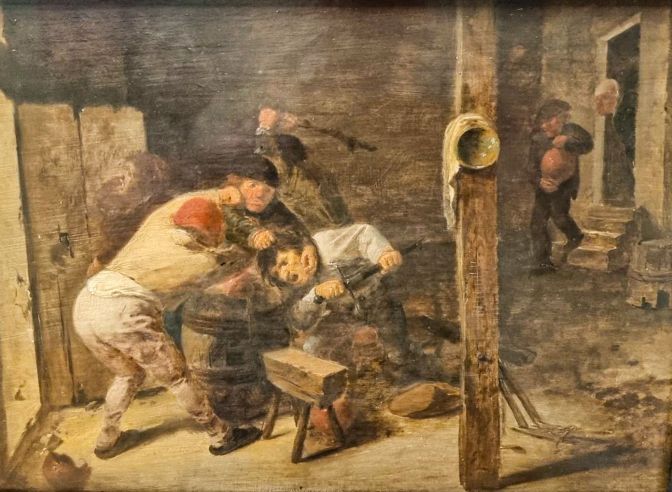
Five Peasants Thrashing One Another
Approximately 25% of all existing Adriaen Brouwer paintings hang in the Alte Pinakothek, and possibly the one with the best moniker is this rowdy scene. It seems like the guy getting his hair pulled and face scratched is taking the brunt of the thrashing while another guy is inventing the golf swing on the peasant in black. The Schoppenhauer in this scene has stepped away to grab a rather large earthenware vessel which most likely is about to give one of these brawlers one helluva headache in the morning.
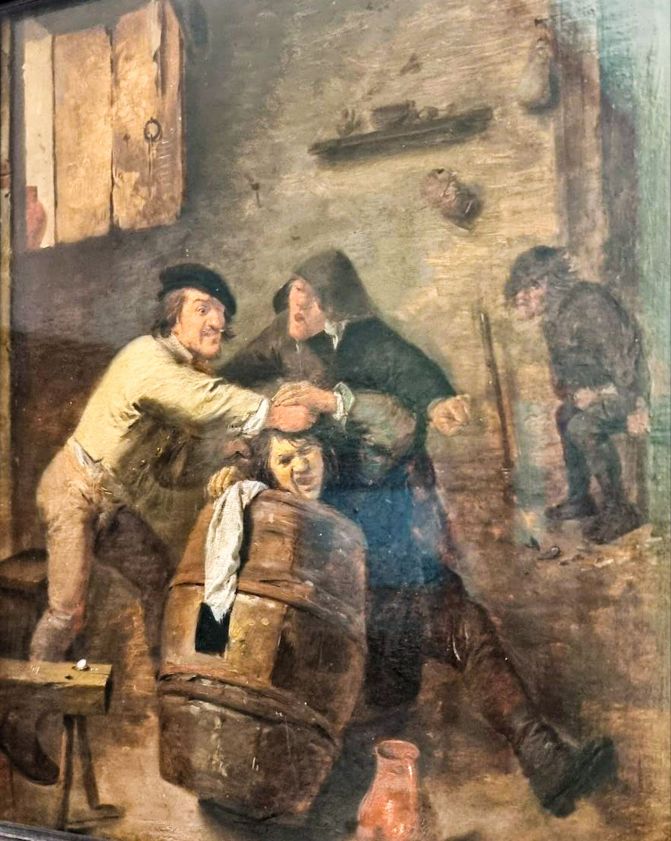
Two Peasants Fighting
I guess the third guy getting his hair yanked doesn’t count as fighting according to the title. Put a guitar in his hand, and that could be Eddie Van Halen doing a string bend. Can’t tell if the second combatant is making a fist or doing a lewd gesture. No Schoppenhauer here, but the red jug in the foreground is just waiting to come to the rescue. You guessed it. Adriaen Brouwer.
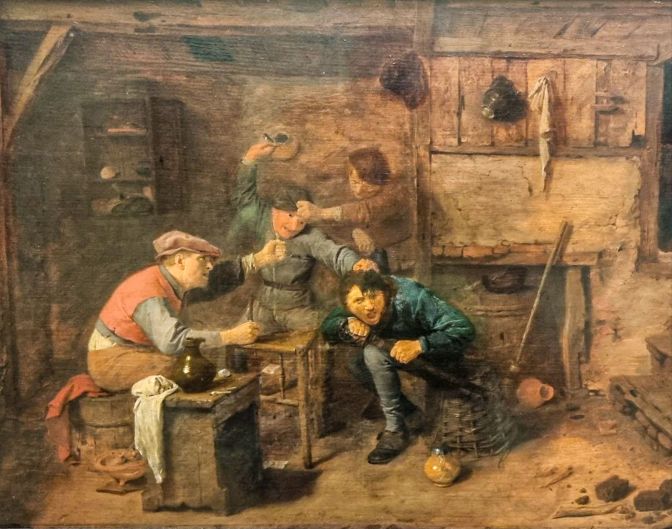
Card Players Scuffling in a Tavern
A trifecta for Adriaen Brouwer. The Schoppenhauer in this painting is about to bring his beer vessel down on someone’s hair-wrenched skull while seemingly unfazed by the punches he is taking to his face from both sides. That is ninja concentration.
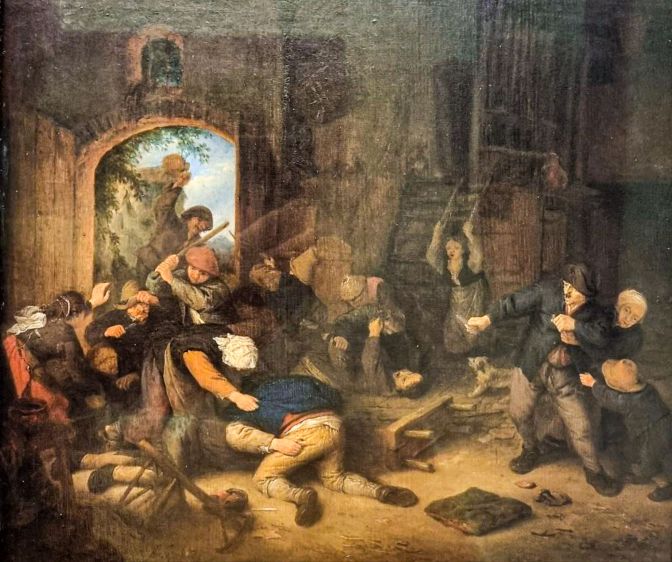
Peasants Fighting
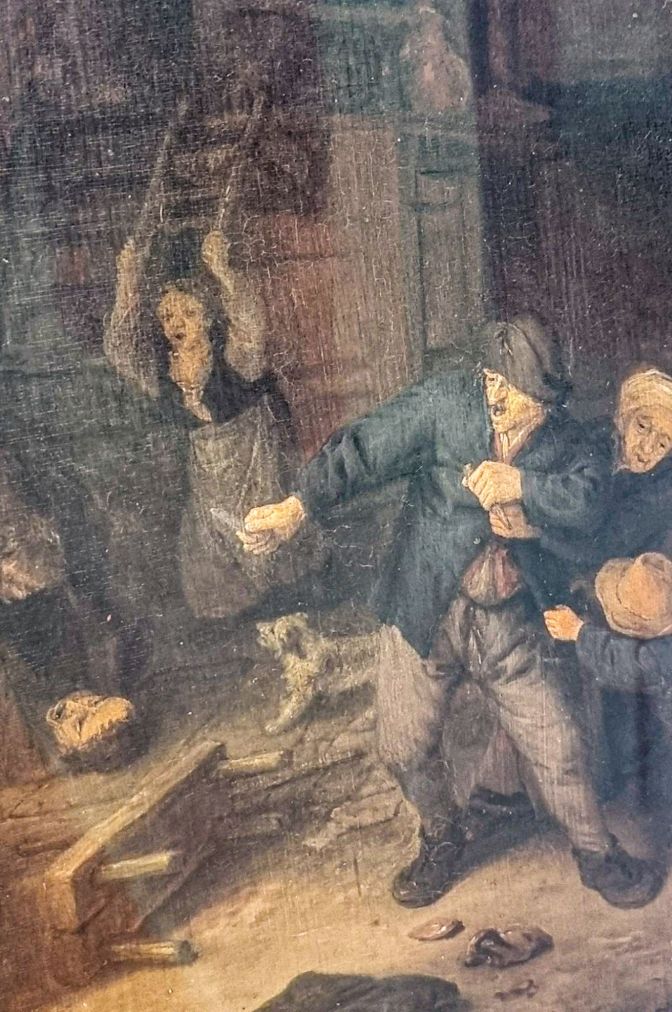
Those naughty peasants. Here we have a full-on brawl from a different Adriaen, Adriaen van Ostade. In this brawl, the men are the ones fighting while the women, as usual, are trying to restore order in this orgy of drunken abandon. One woman is trying to break up a wrestling match but is about to get her rump whalloped by a broom handle while another woman races to her rescue with a chair raised over her head. A third woman holds her knife-wielding husband back from joining the fray before he commits murder and spoils the fun.
Brawl in a Tavern
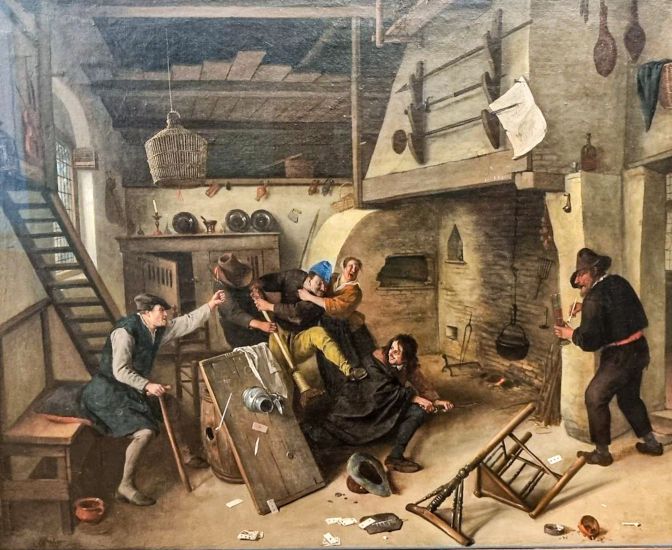
What would a Drunken Masterpieces post be without a Jan Steen? According to the placard, the scene is meant to admonish against quarrelling brought about by gambling and addiction to alcohol. The aggressor is being held back while kicking a guy preparing to unsheath his sword. Perhaps the moral really should be never bring a broomstick to a sword fight. There is no Schoppenhauer here, but the guy on the right has a tall hefeweizen glass ready just in case.
Final Remarks
There you have it folks. Another Drunken Masterpieces in the books. Many thanks to Mr. Large for the unwitting inspiration. Whether in mid-1600 Netherlands or 1930’s Munich, the tavern brawl probably changed very little aesthetically. Under the influence of alcohol, card cheating, being a sore loser, or trash-talking Wagner music2 all can be instigators for this oft-depicted debauchery. While others in the Alte Pinakothek are ooohing and ahhhing over Van Gogh’s brushstrokes, I’d rather be hanging out with peasants in their local watering holes. If there is a card game going on, I’ll just be sitting quietly in the corner minding my own business with a good grip on my beer glass and looking for the nearest broom stick. And if Adriaen Brouwer is around, it might be a good idea to get a haircut first.


 itsabrewtifulworld
Can’t help but wonder if we’re related to Willem Croes, pictured above. I know that your great grandmother, nee Paula Bachem, was born in Reindorf, Germany, in 1889, into a family that owned a brewery. I’ll see if I can find out more about that.
LikeLiked by 1 person