
- Arrival
- Pilgrimage I
- The Three Tuns
- The Chaucer Bookshop
- St. Margaret’s Church / Royal Fountain Hotel
- The Chequers of the Hope
- The Buttermarket (Square)
- Sun Hotel
- The Shakespeare
- The Old Buttermarket
- A Couple of Old Houses
- Bell & Crown
- The Crooked House
- The Dolphin
- The Parrot
- Eastbridge Hospital of St. Thomas the Martyr
- The Old Weavers House
- The Cherry Tree
- The Black Griffin
- Final Words
Arrival
“Coming into Canterbury, I loitered through the old streets with a sober pleasure that calmed my spirits, and eased my heart. ”
Charles Dickens. “David Copperfield”
In Chapter 39, David Copperfield returned to Canterbury, the place where he had many happy memories as a schoolboy, with heaviness on his heart, to meet Agnes Wickfield and her father. It was an emotional chapter and a turning point in the book which I will leave unspoiled for those who have not read it. When I arrived in Canterbury West station in May of this year, preparing to embark on a week in Dickens Land, I was far from loitering and had no wish for sober pleasure. I was bubbling with anxious excitement and eager to drop my things off at my hotel and start exploring. Canterbury in my mind at that moment was only sketches from several dusty old books. As I rounded the corner onto St. Dunstan’s Street which headed into the heart of Canterbury, I was about to leave the Dickens version of Canterbury that I had been reading about and enter the modern one. Meanwhile, words I read in one those books rang in my head.
“Nowhere in the country will you find so many… old houses; some of them in part dating back to the fourteenth century; and Dickens felt the charm of them. Many are now hidden behind ugly modern fronts, but many are yet unspoiled. ”
William Danks “Canterbury” (1907)
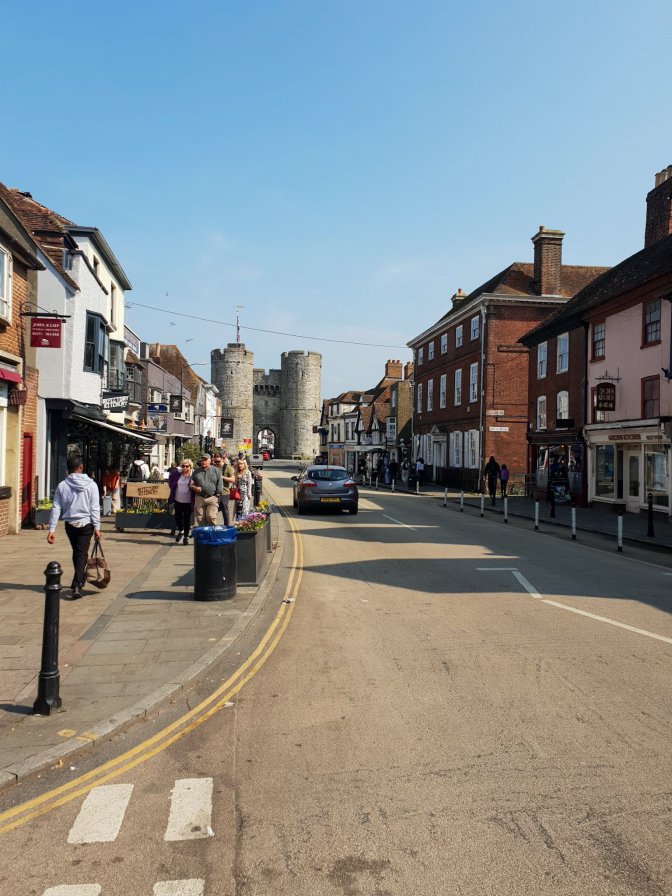
In the distance I could see the iconic West Gate, the last of six city gates still standing. The street before me reached off into the horizon. It started with St. Dunstan’s, then turned into St. Peter’s, which turned into High Street in one chain of uninterrupted charm; bound on both sides by the expected mix of modern façades and the much-anticipated wood and stucco of the medieval houses which bend and tilt at fanciful angles. Classic signs marking the inns and pubs reached out over the street. Canterbury burst into color right before my eyes. I started down that long street towards my hotel and the Dickensian bibulous fate of the next couple of days…
December 29, 1170.
“I will give to the King the things that are the King’s, but to God the things that are God’s. It is my business, and I alone will see to it.”
Gordon Home. “Beautiful Britain: Canterbury” (1911)
These words pierced the private room of the Archbishop of Canterbury, Thomas Becket. Four interrogators, knights from Normandy confronted Becket, who was feuding with the king over who should have the right to try and punish clergymen guilty of crimes. The knights were waiting for rebellious words such as these to justify the act they were intent on accomplishing. The knights stalked Becket into the Canterbury Cathedral and assassinated him. History still doesn’t know whether Henry II issued the order or whether the knights acted alone.
Becket was soon recognized as a martyr and saint and thousands of pilgrims began to flock to Canterbury to Becket’s shrine. These pilgrimages were the inspiration for Geoffrey Chaucer’s Canterbury Tales. In 1538, Henry VIII had Becket’s shrine destroyed and the remains of his body burned during the Dissolution of the Monasteries (the reason why medieval abbeys in England lie in ruins).
“THREE hundred and seventy years have passed since the shrine of St. Thomas at Canterbury was swept away, and the martyr’s ashes were scattered to the winds. The age of pilgrimages has gone by, the conditions of life have changed, and the influences which drew such vast multitudes of men and women to worship at the murdered Archbishop’s tomb have long ago ceased to work on the popular mind. No longer does the merry cavalcade of Chaucer’s lay ride forth in the freshness of the spring morning, knight and merchant, scholar and lawyer, Prioress and Wife of Bath, yeoman and priest and friars, a motley company from all parts of the realm”
Julia Cartwright. “The Pilgrims’s Way from Winchester to Canterbury” (1911)

As I passed thru the West Gate, I was entering the world of the pilgrims of old. How many hundreds of thousands of worshippers passed through these streets seeking food and shelter to finally worship at the shrine of Thomas Becket? I was also entering the world of David Copperfield, Dickens’ pseudo-autobiography. Dickens and his David loitered among these streets along with other classic characters like Mr. Dick, Mr. and Mrs. Micawber, The Wickfields, and the ‘umble villain of the story Uriah Heep. There were a lot of ideas to bring together to compose my own kind of shrine to the brewtiful character of Canterbury. Becket, Chaucer, Dickens, and I will even throw in some Shakespeare. You will hear these names repeatedly. But best of all, great places to drink beer. I had to disagree that the days of the pilgrimages were over1.

Pilgrimage I
In Dickens time, the common way of reaching Canterbury would have been by coach. My hotel, aptly called The Coach House, was once one of these cozy institutions. Grasping for the spirit of the coaching days of yore, I stowed my luggage in the room and emerged back on the old Canterbury streets ready to pay my blessings. Just up the street from my hotel was the first waypoint.
The Three Tuns
“…we reach the Roman road of Watling Street, at the south corner of which (right), and facing St. Margaret Street, stands the “Queen’s Head Inn.” This is “the little hotel” patronised by Mr. and Mrs. Micawber on the occasion of their first visit to Canterbury, as related in chapter 17 of “David Copperfield”
Robert Allbut “Rambles in Dickens’ Land” (1899)
Today standing at this very spot is The Three Tuns pub. While the customary plaque out front mentions the Roman past of this location, nowhere did I find any mention of this possible Dickens link, which for any pub in England would put it squarely on the literary tourism map. However, there are multiple candidates for the little hotel or little inn as it is actually described in Chapter 17. Allbut is the only author I have found who seems sure it is The Queen’s Head Inn. We will meet two others later.
Sidling up to the bar, a row of long handled taps heightened my empassioned thirst. The first beer of the pilgrimage was a Timothy Taylor’s Landlord, a soft bitter ale. Bitters are an enquired taste, but for one week, they would be my constant companion, and when in England, I want nothing else. I sat down at a table while a football match entertained the other guests and faced St. Margaret’s St. just as Allbut described. There I caught my first real glimpse of the tower of Canterbury Cathedral.
I officially had arrived.

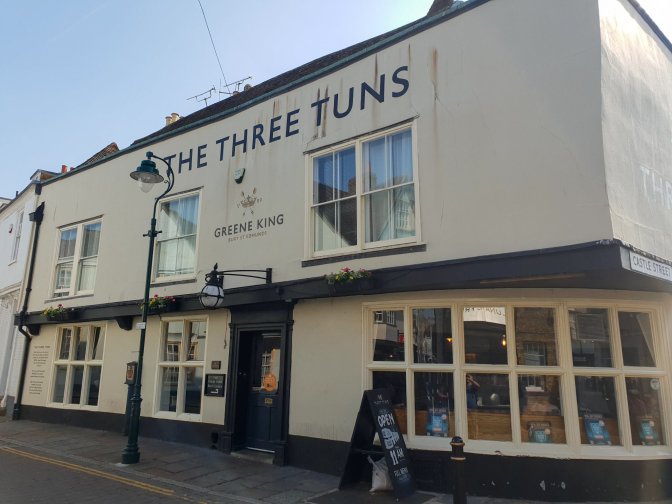
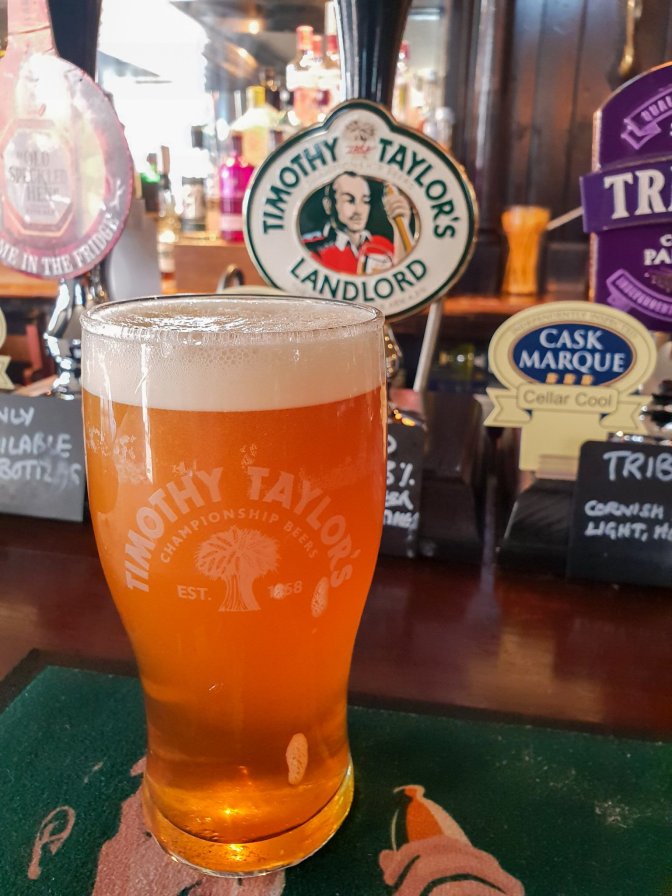

With the Timothy Taylor swirling in my system, I headed out for a short stroll. In this case, you might actually call it loitering.
The Chaucer Bookshop
Just a short walk from The Three Tuns is this quaint bookshop, which unfortunately was on holiday during my visit.

St. Margaret’s Church / Royal Fountain Hotel
A little further on, St. Margaret’s Church is today a Canterbury Tales museum. It sits across from the location where the Royal Fountain Hotel once stood before the Nazi’s destroyed it in WWII. In David Copperfield, the Royal Fountain Hotel, called County Inn in the novel, was where Mr. Dick always stayed when he visited David.


The Chequers of the Hope
On the northwest corner of Mercery Lane and High St. was once a well-known hospice serving pilgrims mentioned in Canterbury Tales called The Chequers of the Hope. It burned down in 1856.

Mercery Lane leads to what seems to be the main square in Canterbury.
The Buttermarket (Square)
The Buttermarket marks the entrance to the Canterbury Cathedral close thru the elaborate Christchurch Gate. The centerpiece of the square is the Canterbury War Memorial.

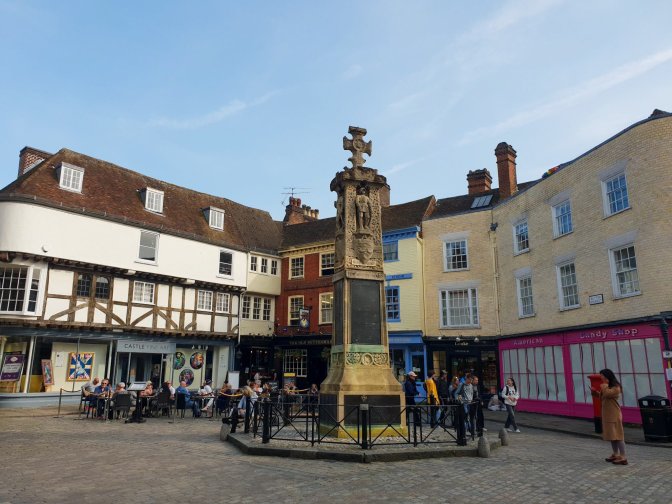
The Buttermarket is also the site of the Cathedral Gate Hotel, which is the second candidate for the Little Inn in Chapter 17 of David Copperfield.
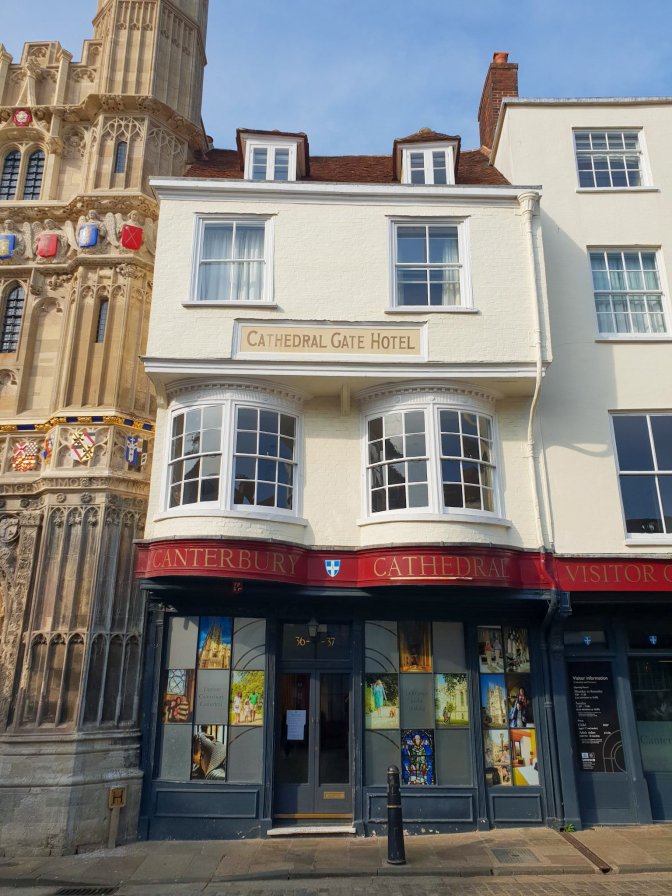
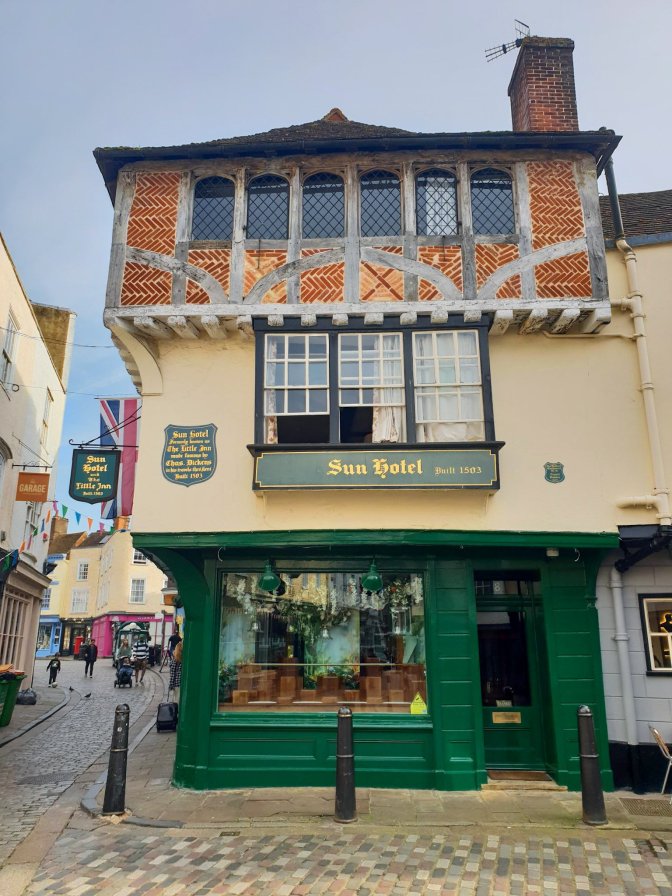
However, it has almost become universally accepted that the real inspiration for the Little Inn is the Sun Hotel just a block away.
Sun Hotel
The Sun Hotel has unabashedly grabbed the mantle on the accepted lore of the old travel writers. It’s plaque proudly associates itself with the Little Inn of David Copperfield.

Heading back through the Buttermarket and to the right, I reach the next pub on the list.
The Shakespeare
The second beer of the day comes in this cozy pub with a small outdoor terrace in the back. The Master Brew by Shepherd Neame, a caramel-colored bitter, was a nice companion as I sat and planned out the rest of my evening.


It was a little bit before dinner time, which for me means power nap when I am travelling; 20 minutes of blissful shut-eye and then back out to dinner and to the Buttermarket.
The Old Buttermarket
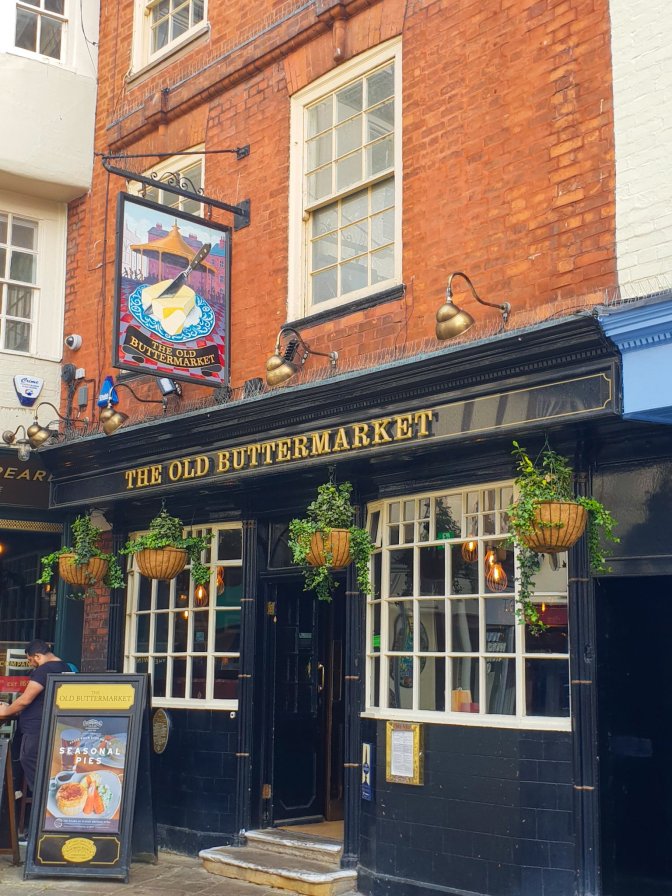
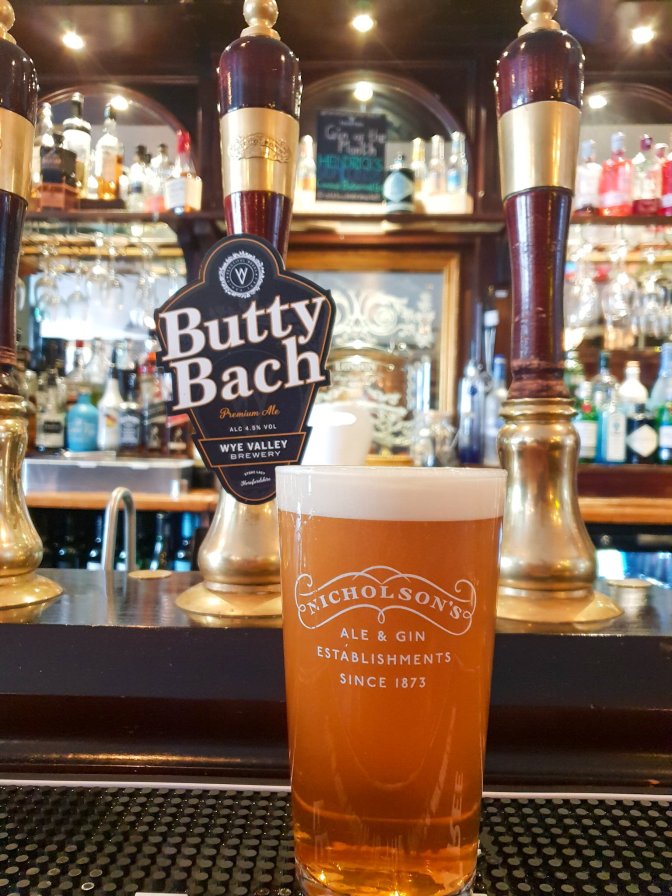
It was a particularly quiet Sunday evening in Canterbury and I had this pub to myself. I chose a table by the window and looked out trying to see the ghosts of the pilgrims who would have gathered here more than 500 years ago or throngs of people watching as Henry II arrived to receive penance for the murder of Becket. I sipped on my Butty Bach (Beer #3) as my gaze shifted between the tranquil outdoor scene and a copy of The Kent of Dickens by Walter Dexter (1924).

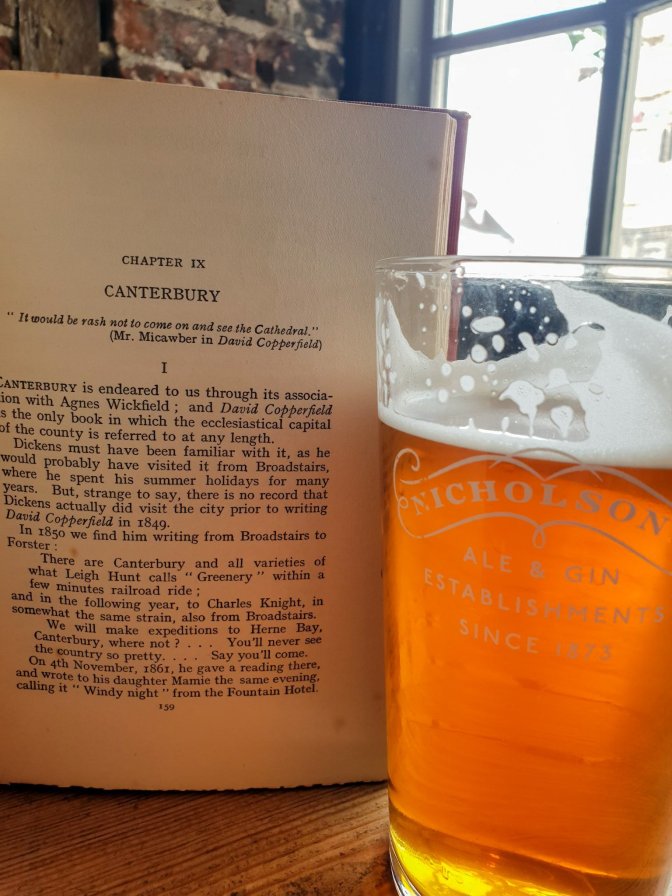
Following dinner, I took an evening stroll to locate more pubs. Canterbury is such a pleasure to walk, the streets twist and curve with plenty of old wood and stucco houses to admire and tickle your curiosity.
A Couple of Old Houses
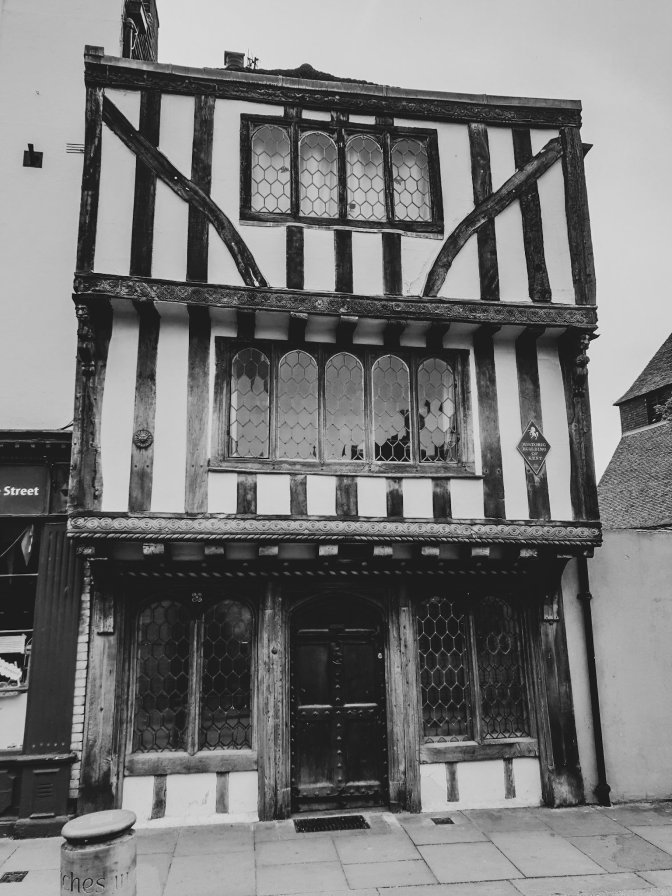

Bell & Crown
A nice pub with a great view of the cathedral towers glowing in the setting sun. Here I had my first local beer (Beer #4), a King Ale by Canterbury Ales.


The Crooked House
Just up the street from Bell & Crown is this oddly-shaped bookstore.


The Dolphin
In the north of historic Canterbury there are two very nice pubs just a short distance from each other; The Dolphin and The Parrot. Since I was going for Beer #5, I decided to choose one and went with The Parrot. However, The Dolphin seems like a local favorite and would normally be worth the stop.

The Parrot
Taking nothing away from The Dolphin, but I do believe I chose the right one. The Parrot is an absolute must for pub lovers. It has a cozy fireplace interior and a lush courtyard terrace. The beer selection, like most traditional pubs, is not so extensive. Spitfire is a common bitter, but I have always loved the name and along with London Pride and Old Speckled Hen is inevitable to have when visiting England. As an attempt to establish literary credibility, The Parrot associates itself with a parrot mentioned in Chaucer’s Canterbury Tales. It is a bit of a stretch, but making literary connections in English pubs is good marketing. Yes, I am talking to you, The Three Tuns.


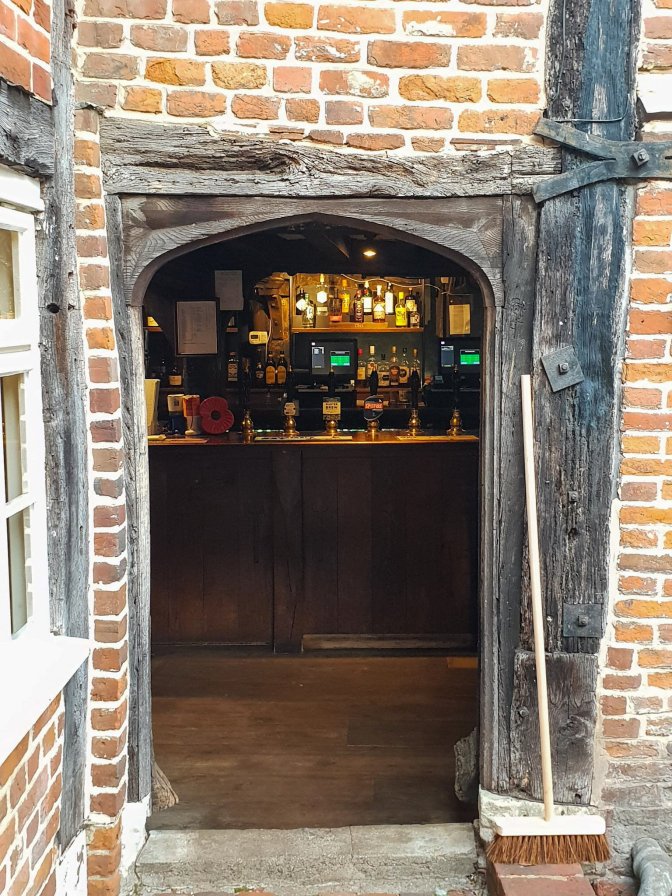


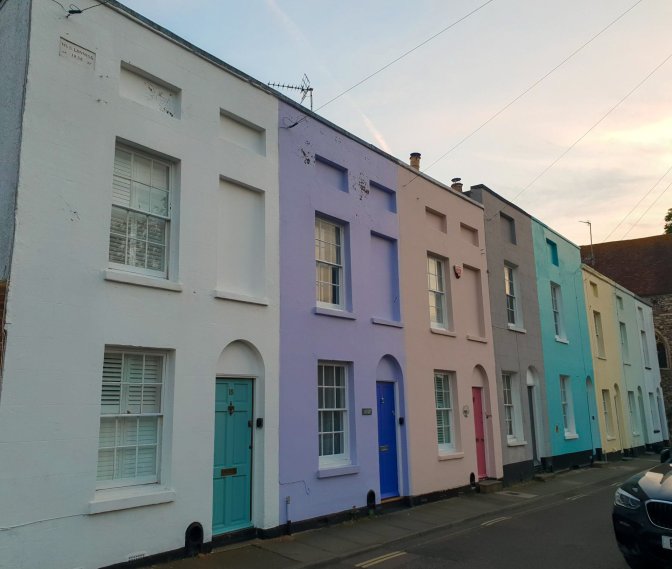
After Beer #5, I continued my blissful stroll finding lots of colorful houses and doors along the way.
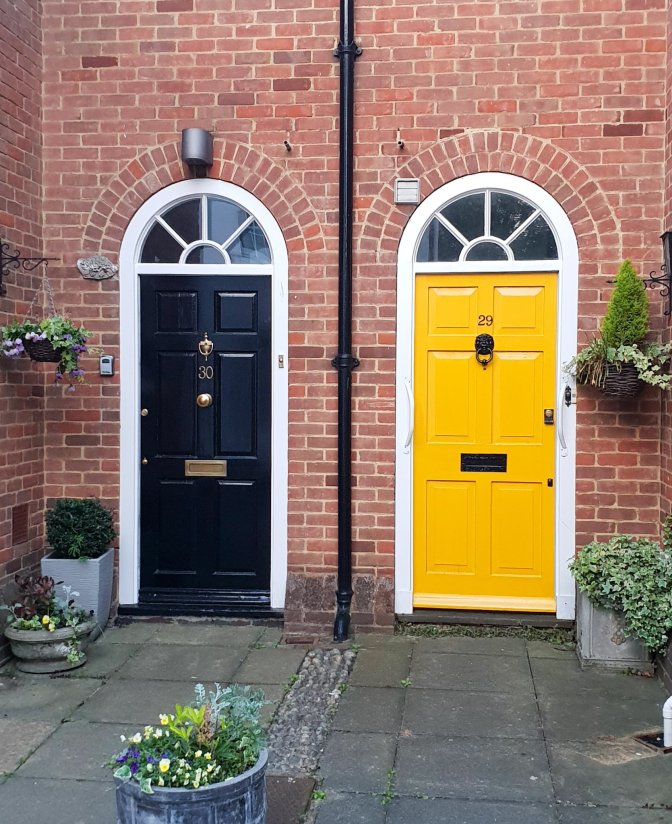
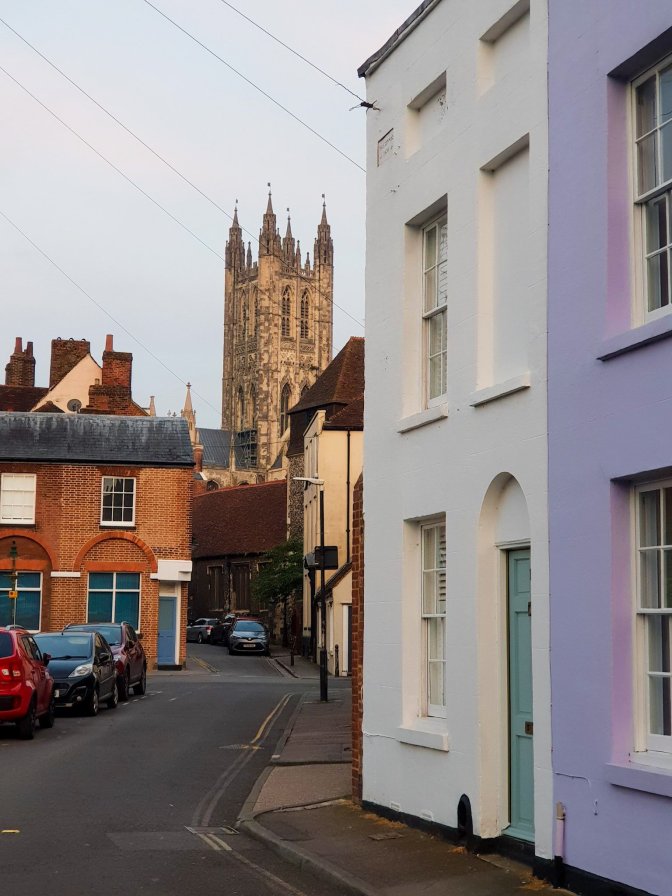

Coming back out to High Street, the sun has set and we start to see Canterbury at night.

Eastbridge Hospital of St. Thomas the Martyr
In the middle ages, the term “hospital” would have referred to a place serving pilgrims. Today, it serves elderly citizens.

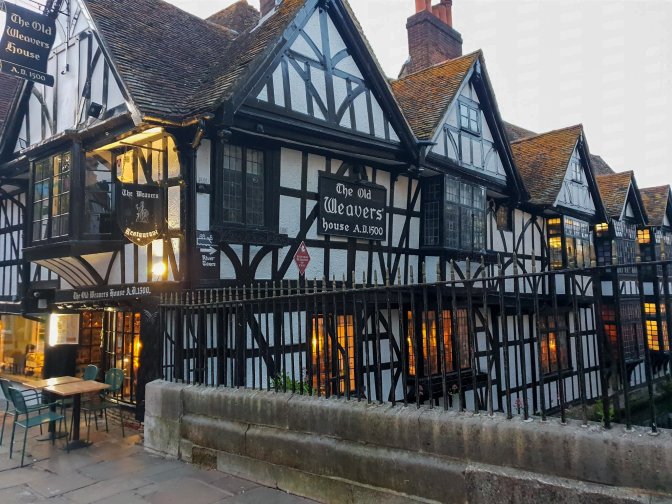
The Old Weavers House
This remarkable building catches your eye and is certainly a visual attraction. I did not have dinner or drinks here. It gives me the impression of a touristy place where the food quality is inversely proportional to its architectural quality; however, it would be careless of me to conclude with that. If I ever make it back to Canterbury, for sure I will give it a try and would gladly accept comments from anyone reading who has been there.
The Cherry Tree
Another pub I only passed by. Everytime I passed this pub, it was crowded and lively, even on this otherwise quiet Sunday evening; so it seems like a local favorite hangout.

The Black Griffin
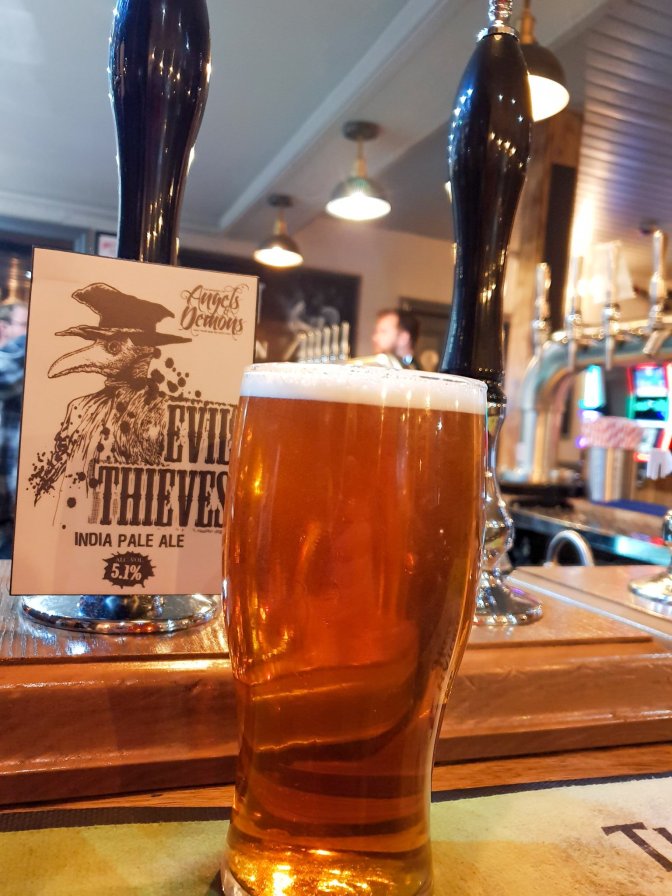
The final stop of the day was this pub along St. Peter’s Street. Pretty nondescript interior, but it had the most unique set of beers on tap of all of today’s pubs. Beer #6 was Evil Thieves, which at 5.1% alcohol was the strongest beer of the day. (Bitters tend to sit in the 3-5% range.)
Final Words
One year prior I did a Dickens-themed visit to London. It was one of the most fun trips trying to piece together a complete itinerary around literature and beer, and it rekindled my love for exploring old texts from the late 1800’s and early 1900’s about travel. There are several such books which focus of the stories of Dickens and often the term Dickens Land is used. While it sounds like a cheesy amusement park, it refers to the County of Kent in southeast England where Dickens spent much of his life and where many of his beloved stories take place. It includes cities such as Dover, Canterbury, Rochester, Maidstone, and Gravesend, basically covering two special routes, The Dover Road and The Pilgrim’s Way, both having special bonds between history and travel. There was no question that this year, I was going to continue my Dickens-themed travels in Kent. England is so rich in history though, that it is inevitable that I would pick up a few historical hitchhikers along the way. The story of Thomas Becket is fascinating, controversial, and chilling when considering the crimes of priests that have made the news in the past 15 years or so. I ordered a biography and cannot wait to immerse myself into it. Meanwhile, as I was sipping my Evil Thieves, I had reached the intermission to this part of the story and the end of Pilgrimage I. Like a pilgrim, perhaps, feeling both unworthy and thankful. I finished the night back in the Coach House laying in bed with visions of cozy fireplaces crackling away, a murmur of voices, the clinking of mugs, the clop of horse’s hooves, and the clang of church bells. But, unlike David Copperfield, it was probably my unsober pleasures which helped me fall asleep.


 itsabrewtifulworld
2 thoughts on “Brewtiful Canterbury Pt. I”