
- Introduction
- Edgar Allan Poe National Historical Site
- Love City Brewing
- Triple Bottom Brewing
- Liquid Art
- Yards Brewing Company
- Raven Lounge
- Monk’s Cafe
- Final Words
Introduction
As I reach Part III of IV in my series of Brewtiful Philadelphia posts, I feel the need to pause for a moment to retrospect. This may be valuable for any new visitor who has stumbled upon my website looking for cool places to have a beer in Philadelphia and suddenly finding themselves mired in confusion by the inundation of Charles Dickens. What does he have to do with Philadelphia? If you want to know where to get a beer, you will find the quick links in the above Table of Contents. But if you are curious about all the rest, please read on.
One of the core fundamentals of my Four Dimensions of Travel which drives all of my blog posts is #4.
Finding those special experiences that give your travels the most fulfilment beyond just what is recommended in a guidebook. Your travel niche, e.g. beer culture, quaint bookstores, specific local cuisine, etc.
Me
Every trip for me is a puzzle. A connect-the-dots puzzle between the place and my soul. I thrive with themes. A theme allows me to start looking for those dots. This means engrossing myself in another love which is reading and scouring dusty old texts. And I find that as long as you have a few dots in place, surrendipity will take care of the rest. There is good karma in this method, I swear to you! And surrendipity creates new pathways to explore and adds exclamation marks to the trip. I prefer a measure of looseness in my planning rather than machine-like precision. When I was planning a trip to London in 2022, Charles Dickens became a theme. And the results were so rewarding that he is entrenched as a Dimension #4 which I will return to again and again. So as far as Philadelphia goes, while Dickens was not a signer of the Declaration of Independence, he visited Philadelphia and wrote briefly about it and that was all the convincing I needed to investigate. The joy which became Parts I and Part II are the core. However, this post is the surrendipity. When I look back at this trip, what I will remember most is a chance meeting with a bird.
Dickens’ former pet raven, Grip, is stuffed and on display in the Rare Books Department at the Parkway Central Library in Philadelphia.

“(letter to George Cattermole, friend & illustrator on Barnaby Rudge, dated Jan 28, 1841)
I want to know whether you feel ravens in general and would fancy Barnaby’s raven in particular… my notion is to have him always in company with a pet raven, who is immeasurably more knowing than himself. To this end I have been studying my bird, and think I could make a very queer character of him.
Charles Dickens. “The Letters of Charles Dickens. Vol. 1, 1833-1856.”
By the time Dickens arrived in America in January 1842, Barnaby Rudge had seen its complete release as a serial. The title character manages to get caught up in riots that were going on in England in 1780 known as the Gordon Riots. His companion, Grip the Raven, became another of Dickens’ memorable characters with a “particular vein of humour” and which became “household words in English literature and English social life”1.

Meanwhile, writing for Graham’s Magazine in Philadelphia, a certain writer reviewed Barnaby Rudge for the magazine in February 1842 while Dickens was on American soil. The author prefaces his review making it clear that it was not his intention “to enter into any wholesale laudation of ‘Barnaby Rudge.'”2 Then comes a carefully and colorfully spun introduction to the benefits of the critique about to unwind.
“It is not excellence if it need to be demonstrated as such. To point out too particularly the beauties of a work, is to admit, tacitly, that these beauties are not wholly admirable.”2
In other words, to compliment is to, in fact, diminish something and “that in pointing out frankly the errors of a work, we do nearly all that is critically necessary in displaying its merits.”2 The reviewer was about to take on a 30-year old Charles Dickens, who was currently in the headlines every day as he was touring around the USA. A Dickens who was only at the beginning of his prime. David Copperfield, A Tale of Two Cities, Bleak House and Great Expectations were still years away. But these were the words of a writer confident in himself, as both a literary critic and as an author. At 33, he is three years Dickens senior and struggling financially. Despite being an admirer of Dickens4, I can’t help but think he was writing this review with a smattering of arrogance, resentment, and desire to upstage his “rival”5.
One of the targets of his critique was Grip.
“The raven, too, intensely amusing as it is, might have been made, more than we now see it, a portion of the conception of the fantastic Barnaby. Its croakings might have been prophetically heard in the course of the drama… although each might have existed apart, they might have formed together a whole which would have been imperfect in the absence of either.”
Graham’s Magazine, Vol. XX, No. 2, February 1842.
Beer & Dickens: Philadelphia Pt. I
What’s the first city you think of when I say Charles Dickens? Nope. It’s Philadelphia. At least for a couple days.
Continue reading Beer & Dickens: Philadelphia Pt. I

Not having read the novel yet, it is hard for me to elaborate how Grip interacts with the story, but my interpretation of these words is that the critic saw potential in the raven as more than just comic relief, but having some greater personal element and perhaps being more integral to the drama unfolding around Barnaby.
Can it be that Dickens’ missed opportunity2 languished in the critic’s soul like some hole in the literary universe that needed to be resolved? Within the next couple of years, he would create a poem in his Philadelphia home. One he intended to be about “beauty” with a “melancholy tone” where each stanza would end with a single-word refrain spoken by a “non-reasoning creature”3. When it came to this creature, he chose a raven. The word was…
Nevermore.
Eh, I already spoiled the suspense in the Table of Contents. But the critic was Edgar Allan Poe.
It is certain that Dickens read Poe’s review. Dickens responds almost immediately with a letter to Poe in March 1842 referring to a portion at the end regarding how a story is constructed. In a published edition of The Raven, Poe includes an essay “The Philosophy of Composition” where he responds to Dickens’ letter with a complete analysis of how he created The Raven. The opening lines of the essay:
“Charles Dickens, in a note now lying before me, alluding to an examination I once made of the mechanism of “Barnaby Rudge…”
Edgar Allan Poe. “The Raven, and The Philosophy of Composition.”
While it is always assumed that Dickens’ Grip inspired the raven of the poem, I found it interesting that Poe starts off contemplating using a parrot before settling on the raven, never giving any acknowledgement to the Dickens association. Maybe this was a deliberate tease or bluff to make sure it was not obvious. But this oft-repeated assumption certainly is plausible. There are three known letters from Dickens to Poe and it is believed that they met during his 1842 visit. I find it fascinating to wonder what they really thought of each other. Did Poe ever respond to Dickens’ letter from March 1842 or did he only reply publicly with the essay included with The Raven? It is with this inspiring literary connection which was thrust upon me with the most surrendipitous delight that I devoted a brewtiful day in Philadelphia to the great Edgar Allan Poe. Dickens, the Victorian bard and Poe, the American Master of the Macabre, connected by a city and a talking bird.

Beer & Dickens: Philadelphia Pt II
Dickens, Dostoyevsky, Shakespeare, and a particular stuffed bird. I must be in Philadelphia.
Continue reading Beer & Dickens: Philadelphia Pt II
Edgar Allan Poe National Historical Site
When I mentioned “looseness in my planning” above, I am referring to situations like the following. I have to admit that I had no idea Edgar Allan Poe had such a big connection to Philadelphia while planning this trip. Since this side-adventure evolved quite late, I excuse myself for missing the fact that this museum is only open from Friday-Sunday. Being there on a Tuesday was mildly anti-climactic. But as I was also in the midst of a couple of brewery visits, I had the necessary ammunition to overcome my grief.
This is one of several houses that Poe lived in and the only one which survives. It is not known precisely which home Poe was living in when he wrote The Raven.
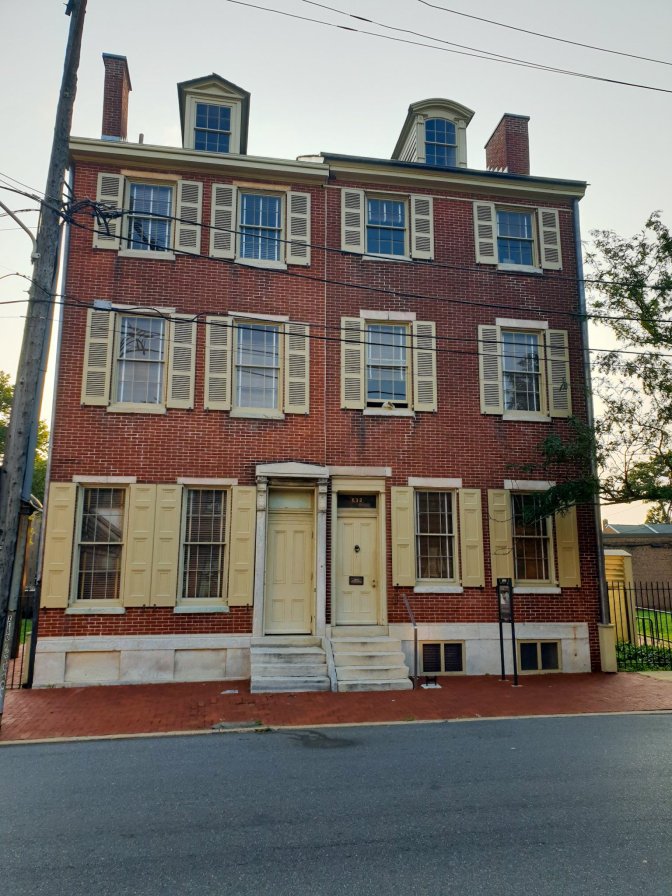
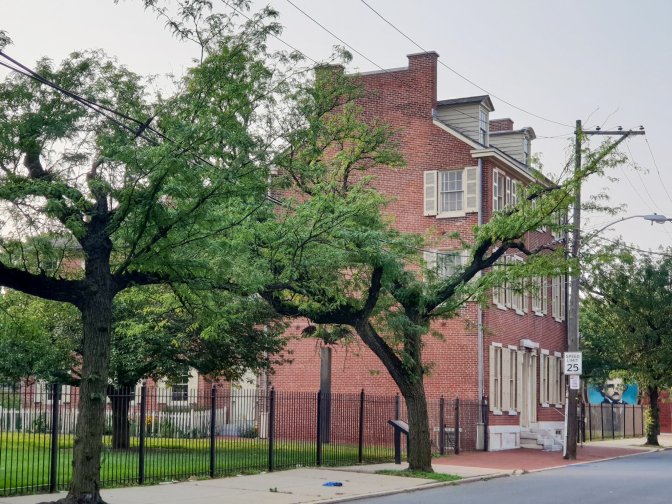
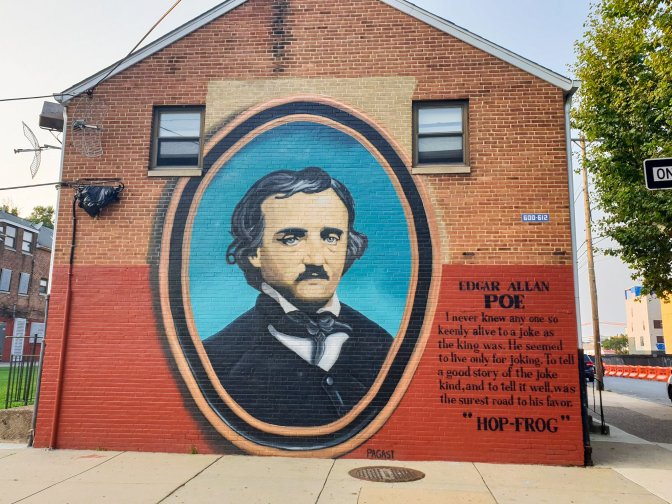

If Poe were living in this home today and suffering from a bout of writer’s block, he’d have no less than four breweries within a very short walking distance to choose from for inspiration. On Tuesday, however, only two of them were open.
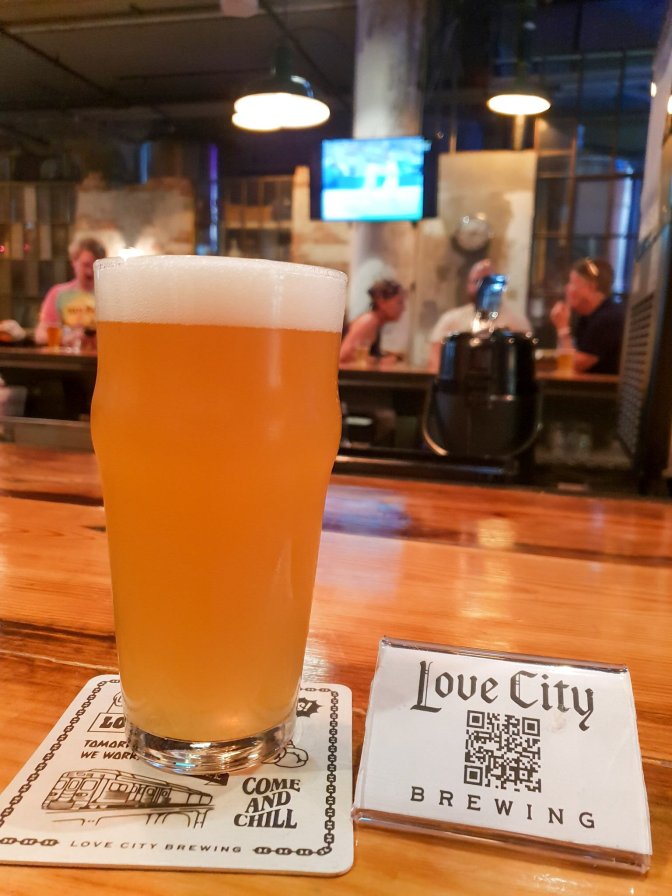
Love City Brewing
Aptly named for Philadelphia, Love City might be my overall favorite taproom experience during my trip. It is a short walk from Chinatown, and at first I was a bit uneasy walking into a neighborhood which is shabby around the edges. But after walking into the large open taproom, having that repurposed industrial warehouse vibe, I realized that rather than just being another tree in the middle of a forest, it was a green sprig rising up from a barren landscape bringing hope. That sensation lingered with me for the entire walk to each of the breweries in this post, as I would alternate between questioning my sanity and suddenly feeling at ease in the presence of the next brewery. What better way is there to invigorate the neighborhood than a Brewing Company?
At Love City, I drank an Eraserhood and Hazy Rider Mango, both Hazy New England IPA’s, a style of beer that has recently launched up to near the top of my list of favorite styles; something a couple years ago I would have grit my teeth in arrogant Belgian beer snobbery and sworn would never happen. However, no worries… nothing will replace the Belgian Triple.


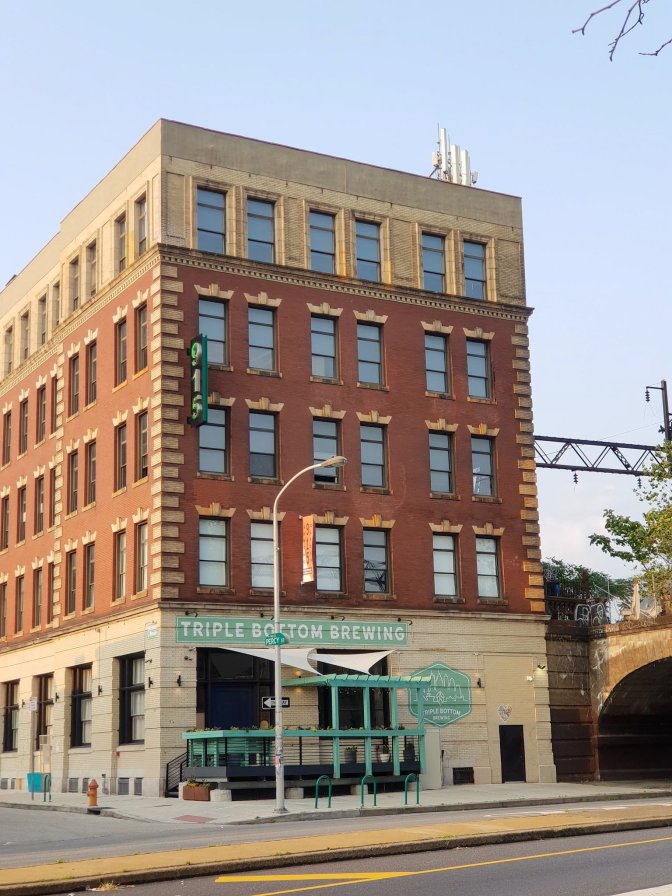
Triple Bottom Brewing
One of the two that weren’t open on Tuesday. This is the brewery that I regret missing the most. I was intrigued by the fact that their beers are featured at the Eastern State Penitentiary.
Liquid Art
This is right across the street from Triple Bottom Brewing and the other one not open at the time. It was not on my original list. Not the best photo to advertise them, but it’s a brewery and that is all that matters.

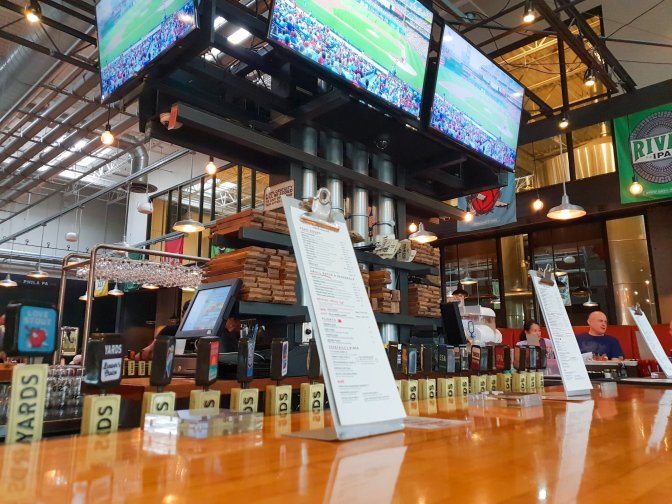
Yards Brewing Company
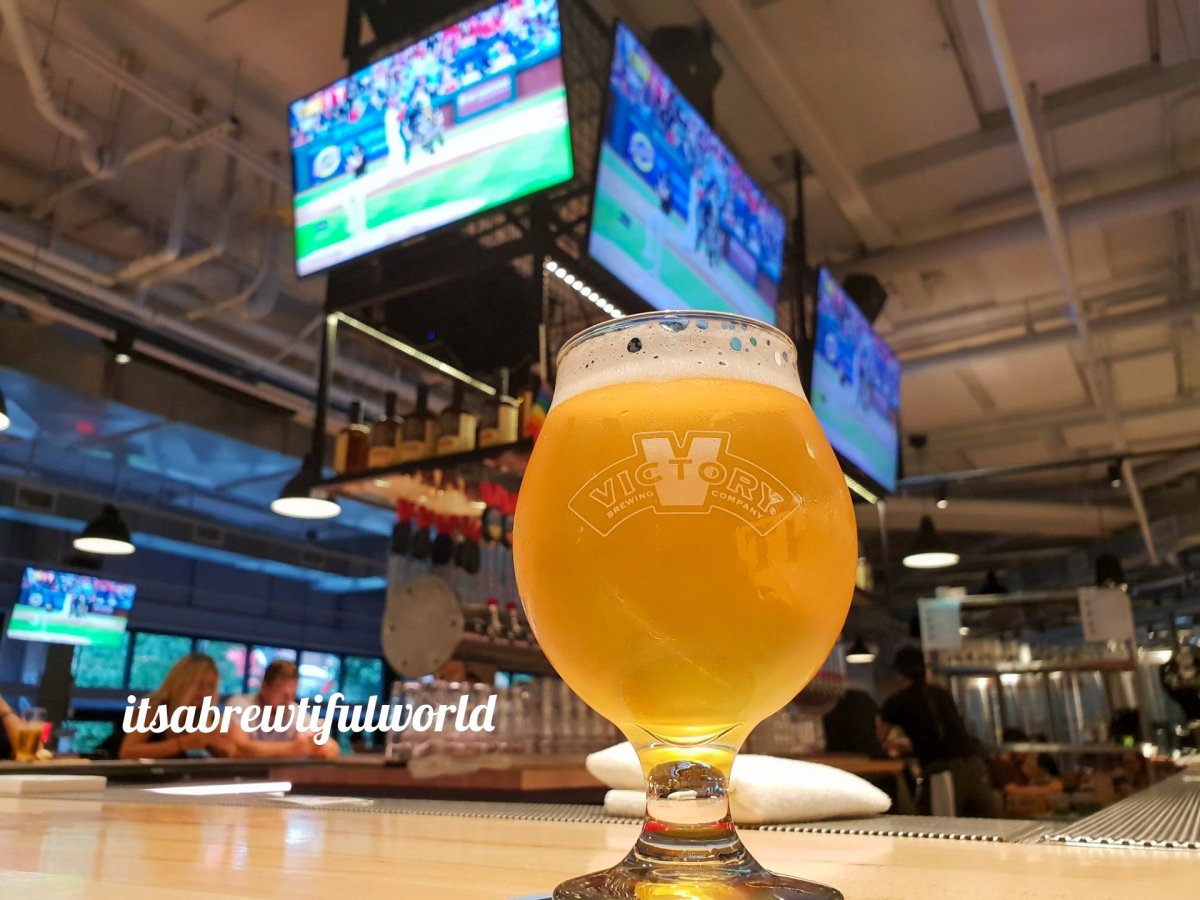
Of the breweries I visited, this one is a verified institution in Philadelphia, already existing since 1994 long before the craft beer boom. I drank a Bit Viper which is naturally a hazy NEIPA. Have you noticed that almost every brewery taproom I visited is showing a Phillies baseball game? I really miss watching these games live in the proper time zone. But I mention this also to drive home the point that the taproom in the USA is a full experience. They are the places to be with a full-scale assault on the senses. Burgers, Beer, Baseball, and Buzz. I love this about the American beer culture.


While none of those breweries fit in any way to the Poe theme other than their vicinity to his home, there is one Poe-themed bar in Philadelphia which is perfect for an after-dark drink.
Raven Lounge
What the pub has in coziness and Poe-ish decor, it lacks in beer selection. I settled for an old Philly classic. However, the intended audience here is not the Untappd crowd but those seeking a dark, intimate Victorian-inspired place to have a drink and conversation about literature. And for that, it is a fantastic place.


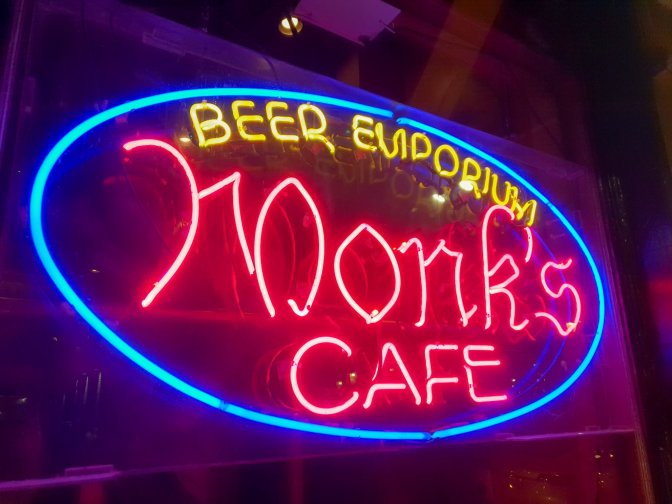
Monk’s Cafe
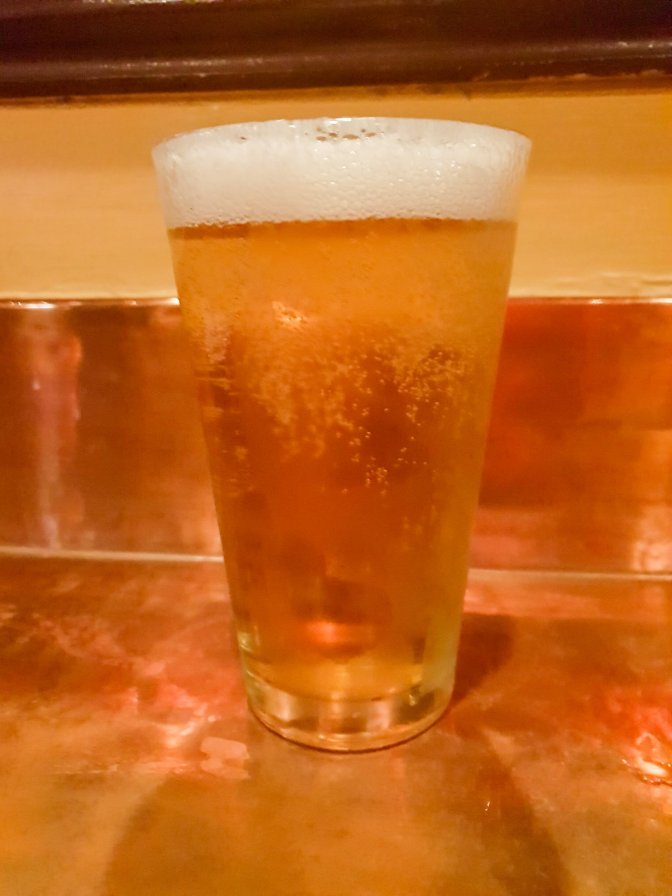
Just a few blocks from Raven Lounge is this pub which is the place to go in Philly for a Belgian beer. While I was impressed with the fact that they had Westmalle Dubbel on tap, I went with a beer already copiously recommended to me in the past; the illustrious Pliny the Elder. While my tastebuds were sending gleeful signals to my brain, a dusty bottle far above the bar caught my eye. With a sudden ache of homesickness, I raised a toast with my delicious Pliny.



Final Words
Poe despised having to write for a periodical like Grahams but would try to get his poem The Raven published thru them. It would be rejected as would many of Poe’s works from various publishers during his time in Philadelphia. So in April 1944, Poe and his wife left Philadelphia for New York City, where in 1845 The Raven would finally be published. Poe would not get to enjoy this success for very long as he died just four years later in 1849, the same year David Copperfield was just starting to come out in serials.
Having grown up as a kid watching the old Roger Corman / Vincent Price Poe adaptations, I think it is fair to say that Poe had as much if not more involvement in my memories as a kid than Dickens’ A Christmas Carol. Today, I still carry a deep-rooted nostalgia for these classic movies and still revisit them from time to time. Having beers with The Raven added an extra level of coming home to my visit to Philadelphia which I hadn’t expected. Chalk another one up to Dimension #4.

References
- Every Saturday Issue August 4, 1866, pg 128
- Graham’s Magazine, Vol. XX, No. 2, February 1842
- “The Philosophy of Composition” by Edgar Allan Poe (1846)
- Charles Dickens Meets Edgar Allen Poe by The Poe Museum (2012)
- Poe is called a “rival” in “The Life of Charles Dickens” by Frank T. Manziels (1887).

 itsabrewtifulworld